A baseball or softball field only works if the numbers behind it are right. One wrong measurement, and the whole game changes — pitchers gain an edge, hitters lose one, and safety takes a hit. we will breakdown the real Baseball & Softball Field Layouts Dimensions you need to know.
This guide covers every baseball and softball field layout dimension you need, from youth leagues to the pros, backed by official rules and real construction steps.
Table of Contents
Baseball & Softball Field Layouts Dimensions at a Glance
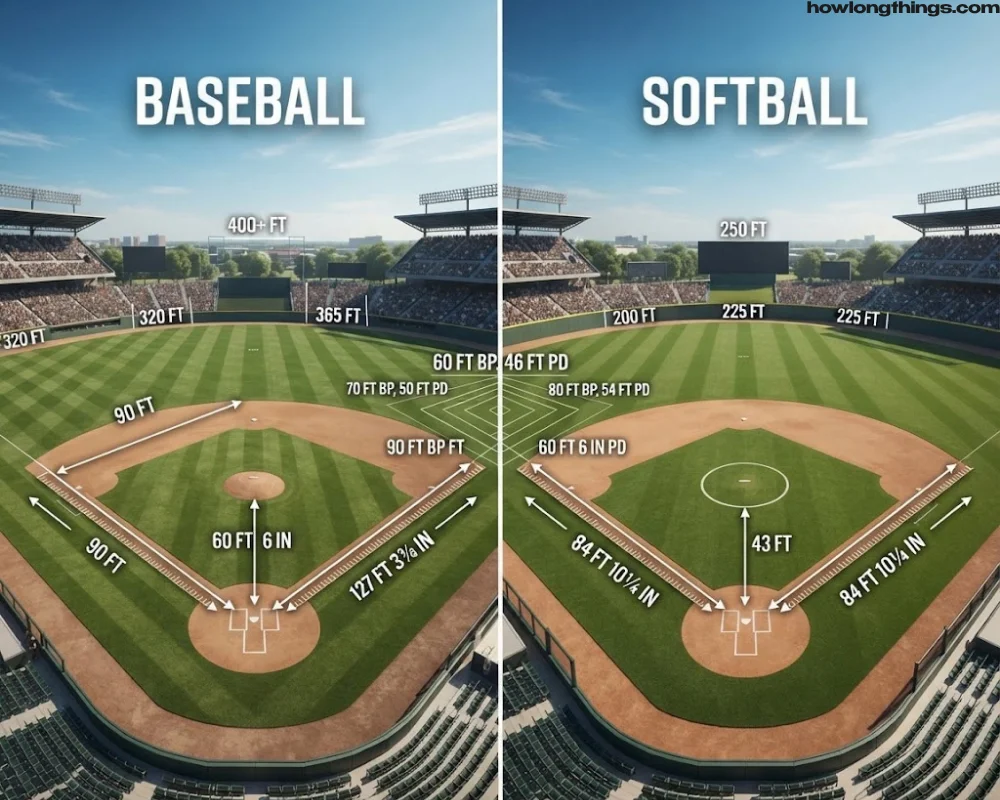
Here is the short answer. A regulation baseball field uses a 90-foot basepath, a 60-foot 6-inch pitching distance, and an outfield fence set between 320 and 400+ feet. A regulation softball field uses a 60-foot basepath, a 43-foot pitching distance, and an outfield fence between 200 and 250 feet.
Softball keeps every measurement tighter. That single design choice shapes how fast the entire game moves.
Field Part
Baseball
Softball
Basepath
90 ft (27.43 m)
60 ft (18.29 m)
Pitching distance
60 ft 6 in (18.44 m)
43 ft (13.11 m)
Home plate to 2nd base
127 ft 3⅜ in (38.80 m)
84 ft 10¼ in (25.86 m)
Outfield fence
320–400+ ft
200–250 ft
Pitcher’s mound
Raised, 10 in high
Flat pitching circle
Softball Field Layout Explained: Every Dimension Broken Down
A softball field layout follows the same basic shape as baseball — a square infield wrapped by a fan-shaped outfield — but every distance inside it shrinks to match the underhand pitch and the bigger ball.
Softball Infield Layout
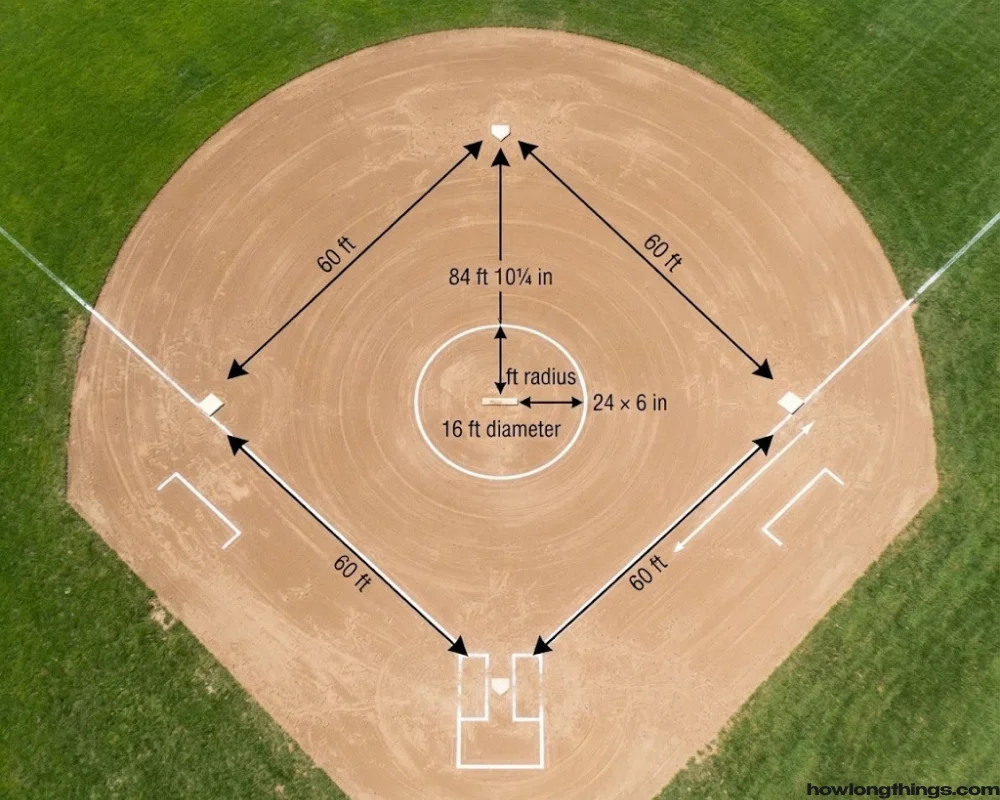
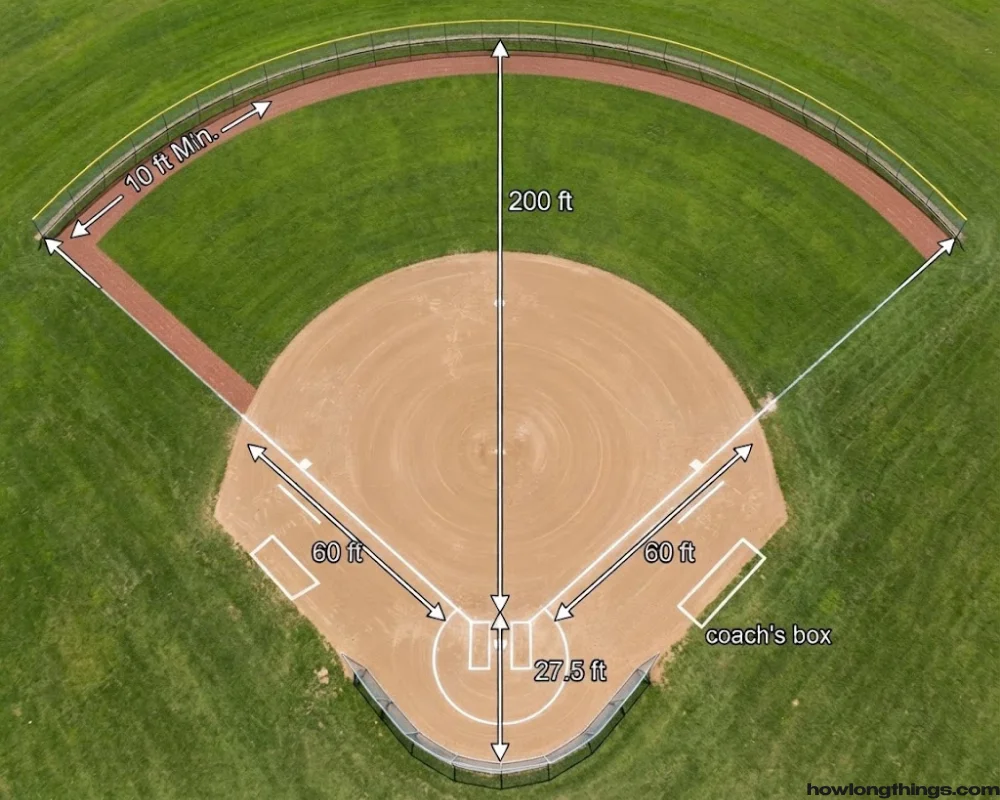
The baselines run 60 feet between each base. The infield hypotenuse — the diagonal from home plate to second base — measures 84 feet 10¼ inches, which squares the diamond. In the middle sits the pitching circle, an 8-foot radius (16-foot diameter) around a 24-by-6-inch pitching rubber.
Home Plate, Batter’s Box and Catcher’s Box
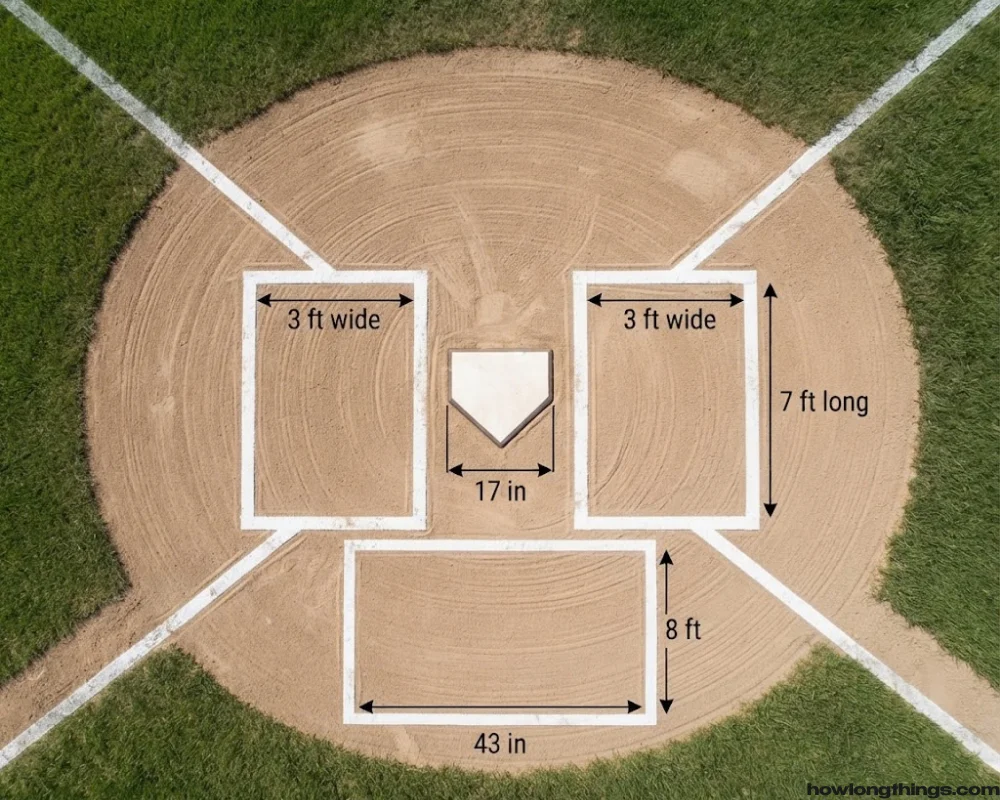
Home plate is a five-sided slab of white rubber, 17 inches across the edge facing the pitcher. The batter’s box on each side measures 3 feet wide by 7 feet long, and the catcher’s box sits directly behind the plate.
Backstop, Foul Lines and Outfield Fence
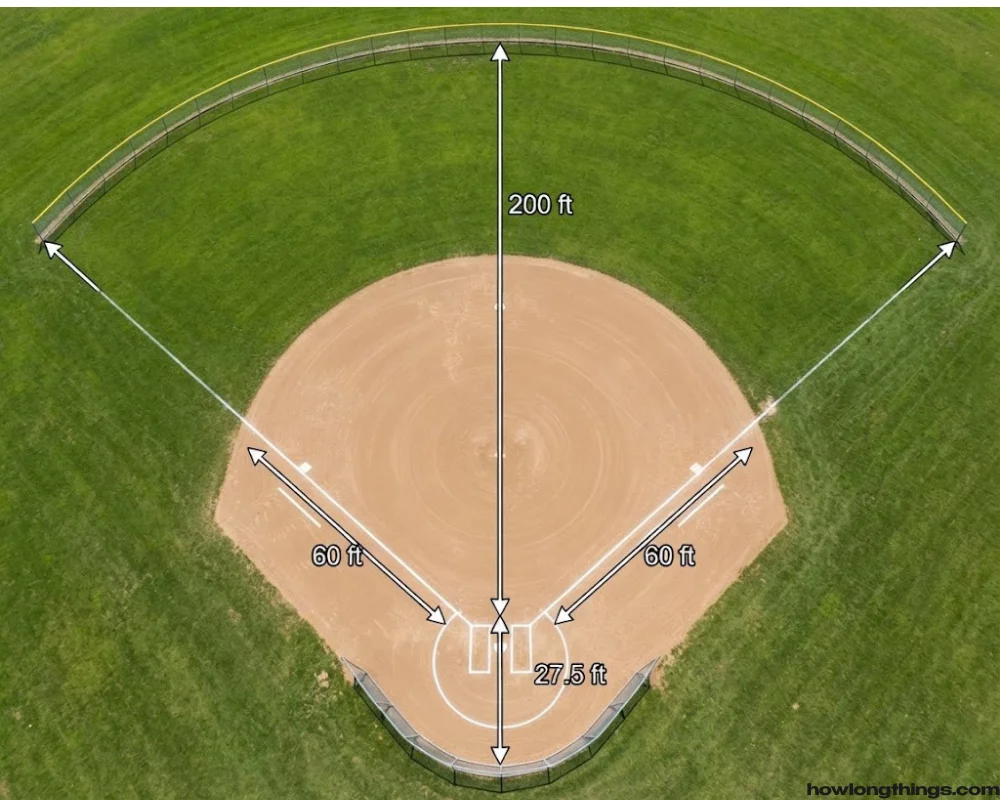
The backstop sits 25 to 30 feet behind home plate. Foul lines run from home plate through first and third base out to the fence. Fence distance depends on the level of play — Little League sets girls’ softball at 200 feet across every division.
Coach’s Box and Warning Track
Coach’s boxes line up along the outside of the foul lines near first and third base. A warning track — at least 10 feet wide — runs along the inside of the outfield fence so outfielders feel the change in surface before they hit the wall.
Baseball vs Softball Field Dimensions: Why They Differ
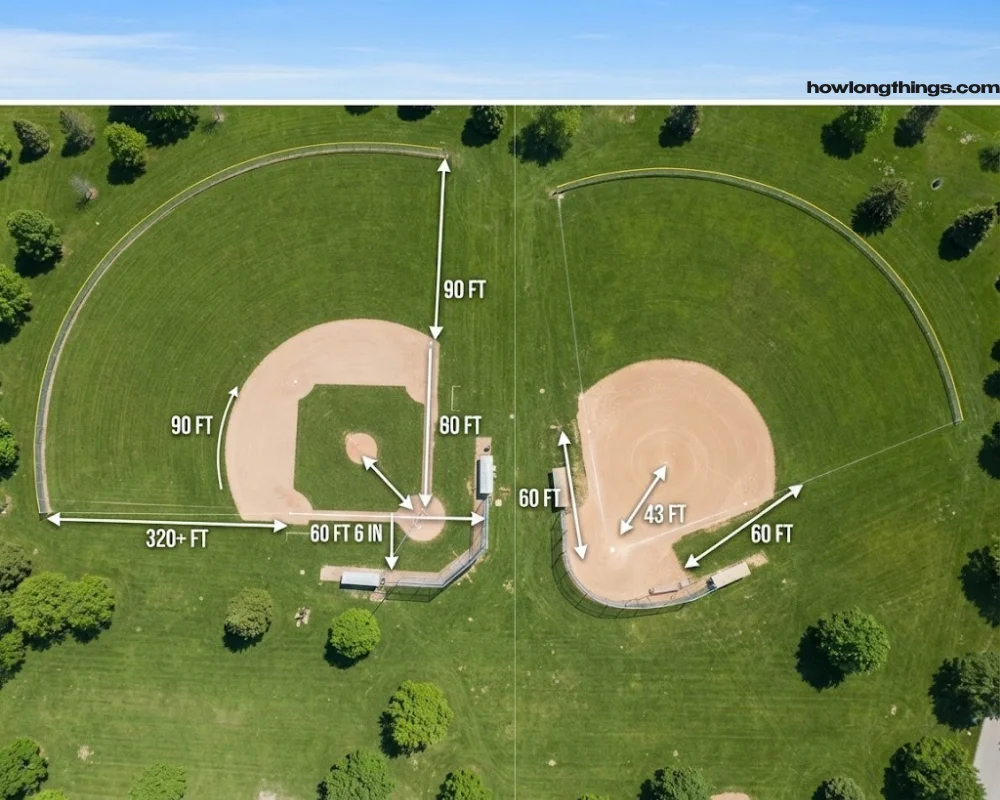
Put a baseball and softball field side by side, and the gap is obvious. Softball trims almost every distance by roughly a third.
Baseline, Pitching Distance and Fence Distance Compared
Basepath drops from 90 feet to 60 feet. Pitching distance drops from 60 feet 6 inches to 43 feet. Outfield fence drops from 320+ feet to as little as 200 feet. Every number shrinks together, which keeps the game balanced instead of lopsided.
Why a Softball Field Is Smaller Than a Baseball Field
Softball is smaller because of three things working together: an underhand pitching motion, a 12-inch ball that is bigger and easier to make contact with, and a faster overall pace of play. A shorter pitching distance offsets the extra reaction time hitters get from watching an underhand release, so the contest between pitcher and batter stays fair.
Is a Baseball Field a 90 Degree Angle?
Yes — a baseball field’s infield is a true 90-degree square. Home plate, first base, second base, and third base sit at the four corners of that square, and the foul lines meeting at home plate form a 90-degree angle. Field builders confirm the square is accurate by checking that the diagonal from home plate to second base measures exactly 127 feet 3⅜ inches, which is simple geometry (the Pythagorean theorem) applied to a 90-foot square.
Baseball and Softball Field Dimensions by League and Level
Field size grows with the players. Below is how baseball and softball field dimensions change across USA leagues and levels.
Little League, Intermediate, PONY and Babe Ruth
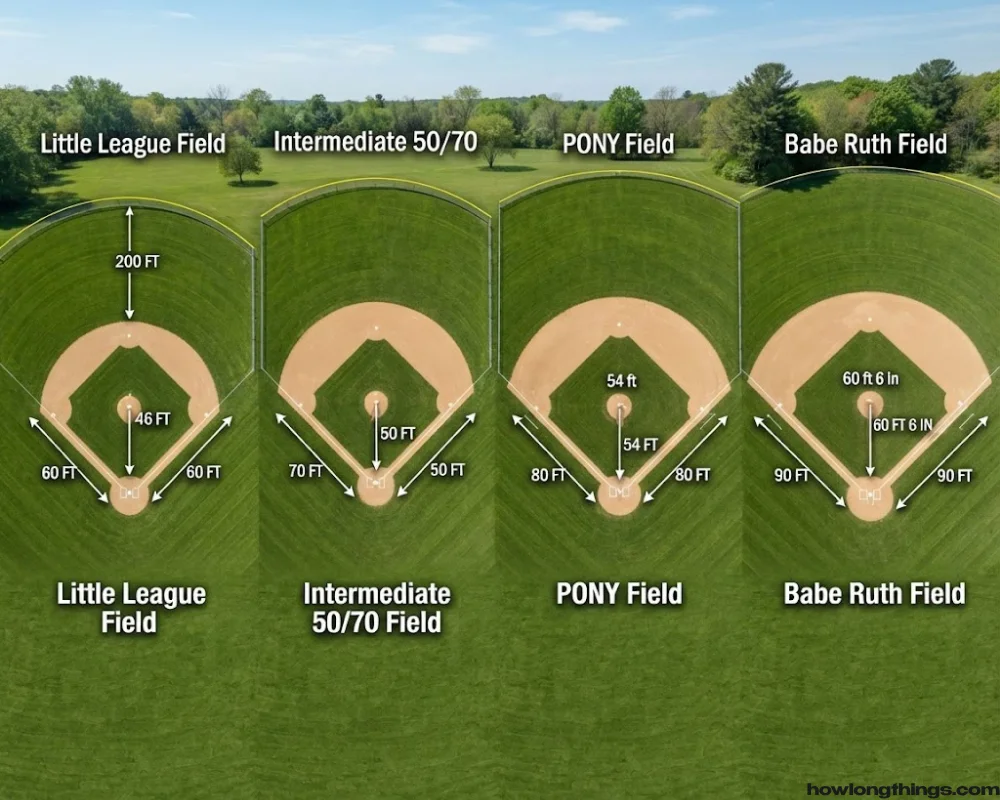
Little League uses a 60-foot basepath and a 46-foot pitching distance for 12-year-olds and below, with a recommended 200-foot outfield fence, according to Little League’s official field specifications. Intermediate (50/70) baseball steps up to a 70-foot basepath and 50-foot pitching distance. PONY League plays on an 80-foot basepath with a 54-foot mound. Babe Ruth moves up to the full 90-foot, 60-foot-6-inch layout for older divisions.
High School and College Field Dimensions
High school (NFHS) and college (NCAA) baseball both use the full-size field: a 90-foot basepath and a 60-foot-6-inch pitching distance, with a minimum recommended fence distance of 320 feet down the lines. Softball at these levels holds the 60-foot basepath with a 43-foot pitching distance.
MLB Baseball Field Dimensions
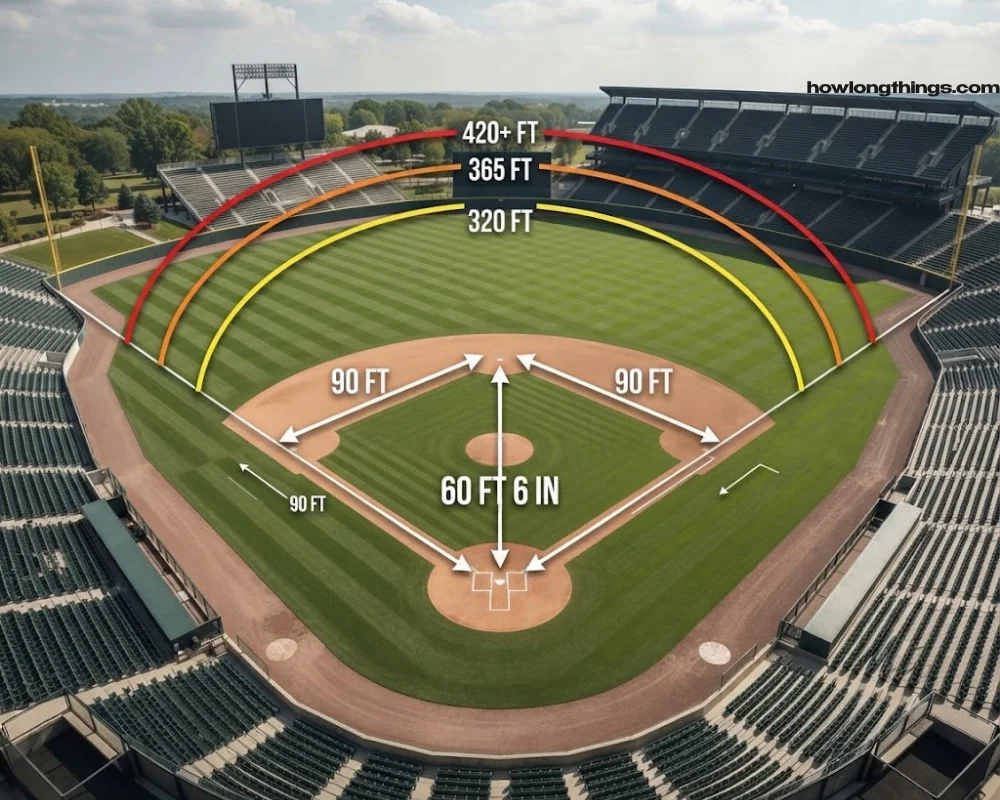
Major League Baseball keeps the same 90-foot basepath and 60-foot-6-inch pitching distance as college and high school ball. What changes park to park is the outfield fence — most modern stadiums sit between 320 and 420+ feet, giving every ballpark its own personality.
USA Softball Fast Pitch and Slow Pitch Levels
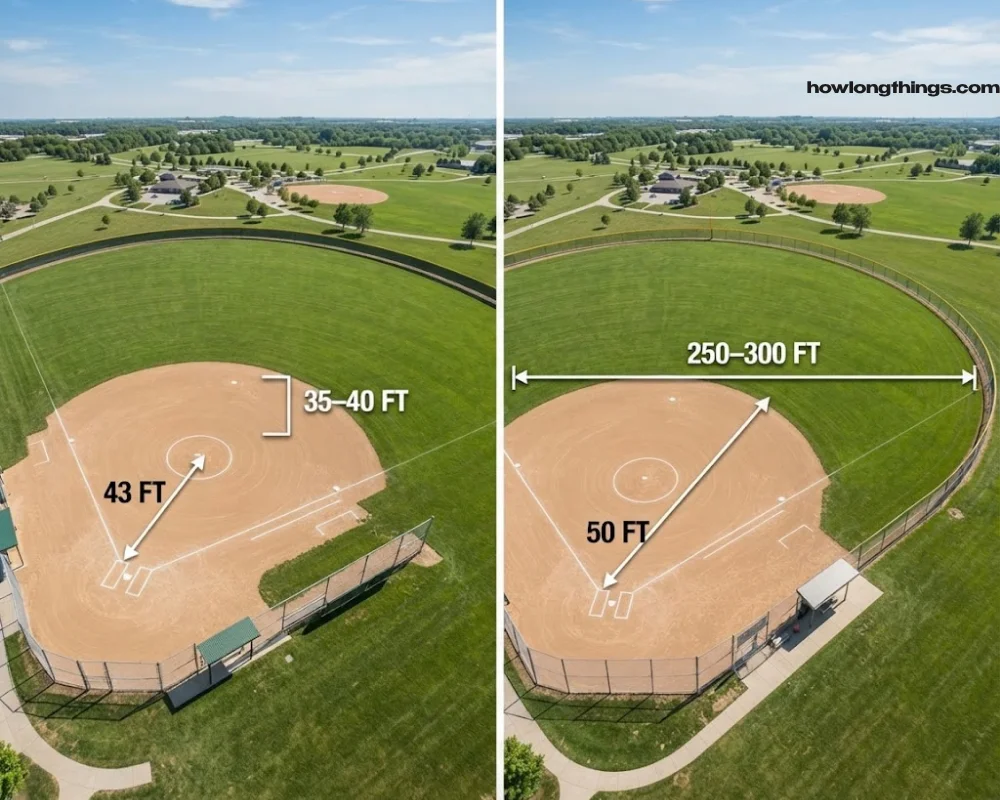
Fast-pitch softball holds a 43-foot pitching distance at the college and high school level, while youth divisions shorten that to roughly 35–40 feet depending on age. Slow-pitch softball pushes the pitching distance out to around 50 feet and stretches the outfield fence anywhere from 250 to 300 feet.
Field Layout, Grading and Slope: A Construction Guide
Building a field from bare ground takes patience more than expertise. NC State University’s Extension turf program breaks the process into simple, repeatable steps.
Step by Step Field Layout Process
Mark home plate first — every other measurement is taken from its back corner, called the apex.
Measure 127 feet 3⅜ inches from the apex to set second base (60 feet for youth and softball fields).
Use two tapes stretched from home plate and second base to find first and third base where they cross.
Center the pitching rubber on a taut string running from the apex through second base.
Run string lines down both foul lines from home plate to the outfield fence, then set the foul poles.
Pitcher’s Mound Height and Slope
A regulation baseball mound is 18 feet across and rises 10 inches above home plate. The front slope starts 6 inches ahead of the pitching rubber and drops 1 inch for every 1 foot of distance toward home plate, per NC State Extension’s field-building guide. Softball skips the raised mound entirely and uses a flat pitching circle instead.
Infield Grading and Drainage Slope
Home plate, first base, and third base should sit level with one another — the only intentional slope on the entire field belongs to the pitcher’s mound. A well-built infield mix runs 50–75% sand blended with clay and silt, giving the surface enough firmness to drain quickly without turning hard or dusty.
Common Field Layout Mistakes
The two most common errors are placing second base at its front edge instead of its center, and misjudging the mound’s 10-inch height. Both mistakes throw off every other measurement on the field, since so many distances are taken from those two points.
FAQs About Baseball and Softball Field Dimensions
What Are the Dimensions of a Baseball and Softball Field?
A baseball field uses a 90-foot basepath, 60-foot-6-inch pitching distance, and 320–400+ foot outfield fence. A softball field uses a 60-foot basepath, 43-foot pitching distance, and 200–250 foot outfield fence. Youth levels shrink these numbers further depending on age group.
What Is the Layout of a Softball Field?
A softball field layout is a 60-foot square infield with home plate, first, second, and third base at each corner, an 8-foot-radius pitching circle in the center, and an outfield reaching 200 to 250 feet to the fence. A backstop sits 25–30 feet behind home plate, and foul lines run from the plate through first and third base to the outfield fence.
Why Is a Softball Field Smaller Than a Baseball Field?
A softball field is smaller because the underhand pitch, the larger 12-inch ball, and the faster pace of the game all call for shorter distances to keep play fair. Shrinking the basepath and pitching distance balances out the extra time hitters get from an underhand release.
What Is the Perfect Slope for a Softball Field?
A softball field itself should stay level — softball has no raised pitching mound, so the infield and outfield are graded flat rather than sloped. The only grading concern is drainage: a gentle, even grade away from the infield skin keeps water moving without creating high or low spots that affect ball roll.
Is a Baseball Field a 90 Degree Angle?
Yes, a baseball field’s infield is a perfect 90-degree square, with home plate, first base, second base, and third base at the corners. The foul lines that extend from home plate through first and third base meet at exactly a 90-degree angle.
Final Thoughts
Whether you are laying out a youth diamond or double-checking a regulation field, these baseball and softball field layouts dimensions give you the numbers to build it right the first time. Measure twice, square the corners, and the rest of the game takes care of itself.
Elizabeth Queen is a Owner and consumer research writer at HowLongThings.com, specializing in product lifespan, durability, and everyday household research. She’s passionate about helping readers make smarter, longer-lasting buying decisions.