Ever held a dollar bill up to a ruler? Most people never have. But the size of US paper money is exact, tested, and the same for every bill in your wallet.
This guide breaks down the real dollar bill dimensions — in inches, centimeters, and millimeters — plus the history, the denomination facts, and the everyday reasons this size matters more than you’d think.
Table of Contents
Official Dollar Bill Dimensions (Length, Width & Thickness)
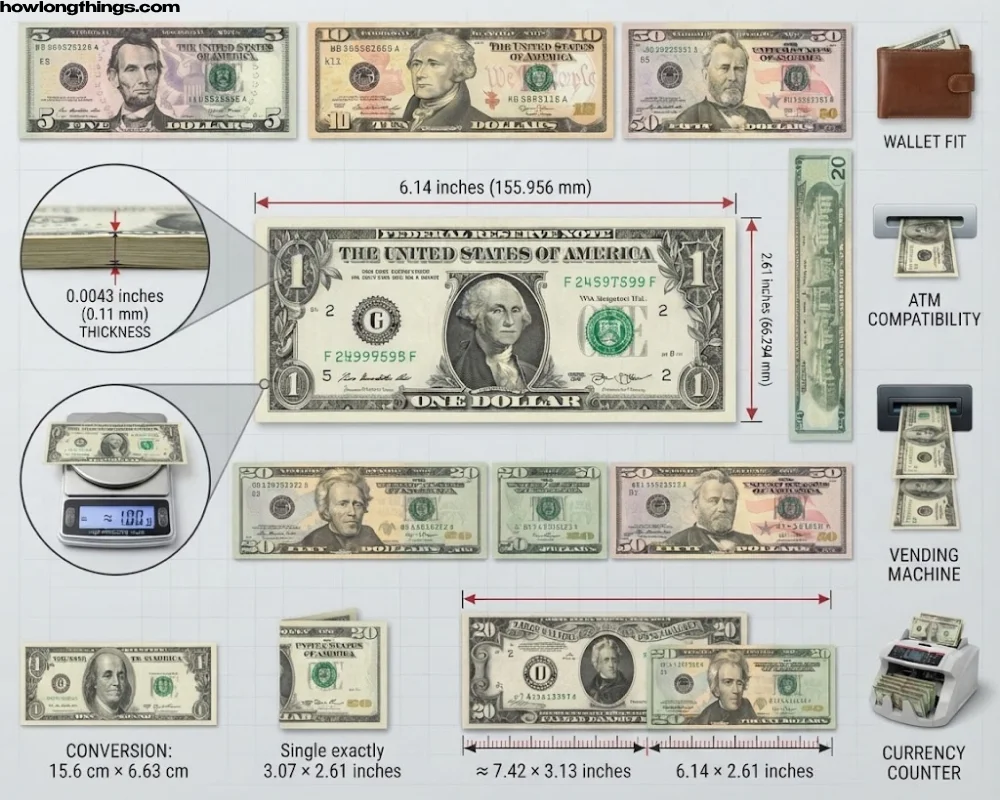
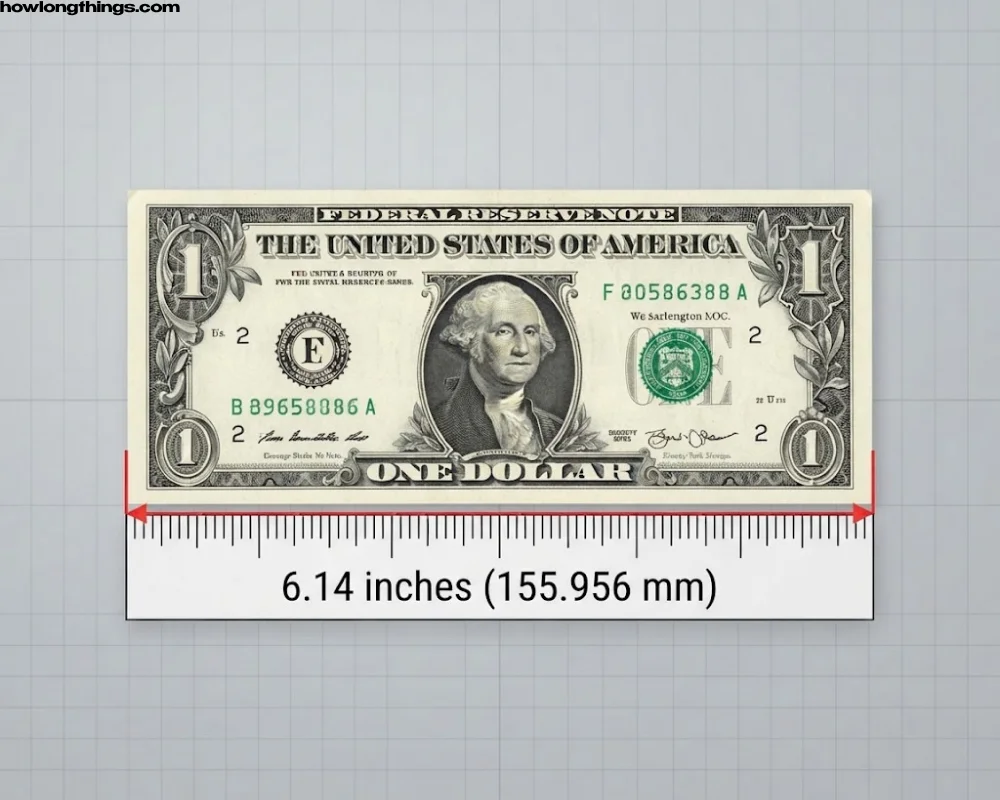
A US dollar bill measures 6.14 inches long and 2.61 inches wide. That’s the standard for every Federal Reserve note in circulation today.
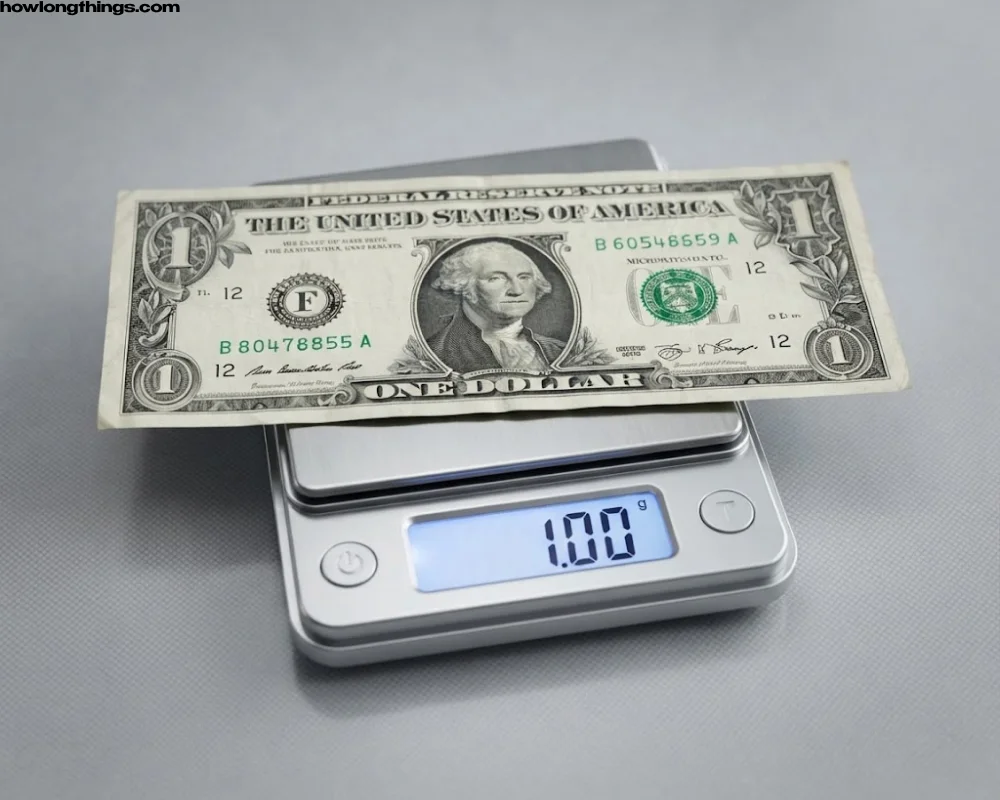
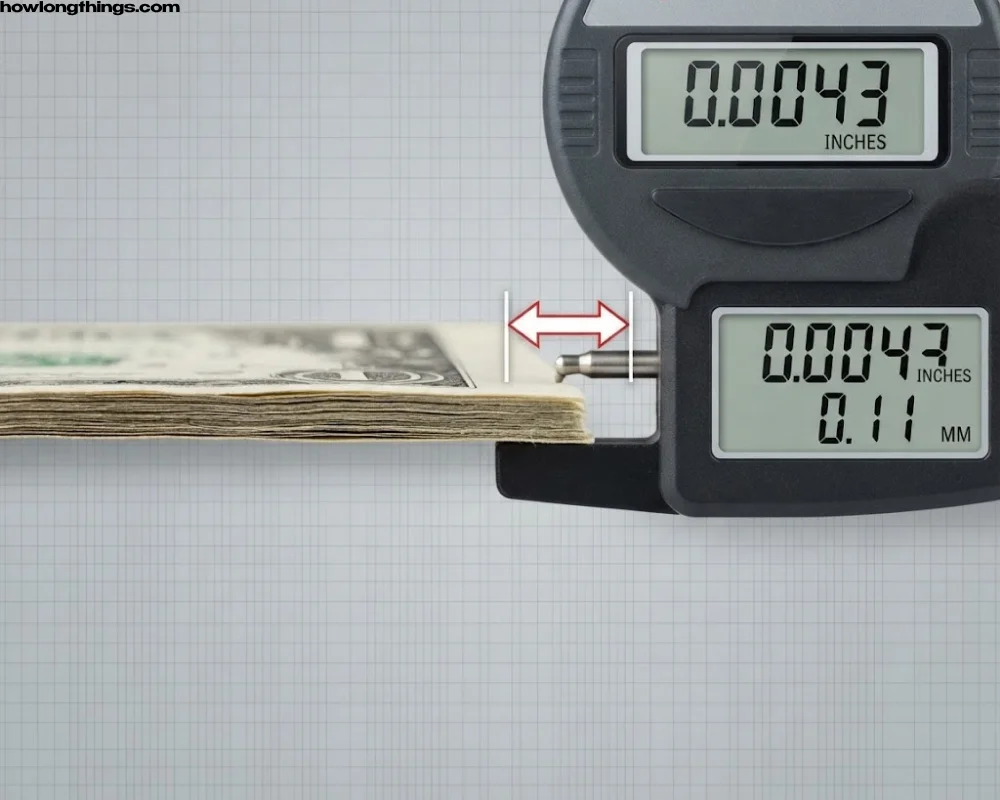
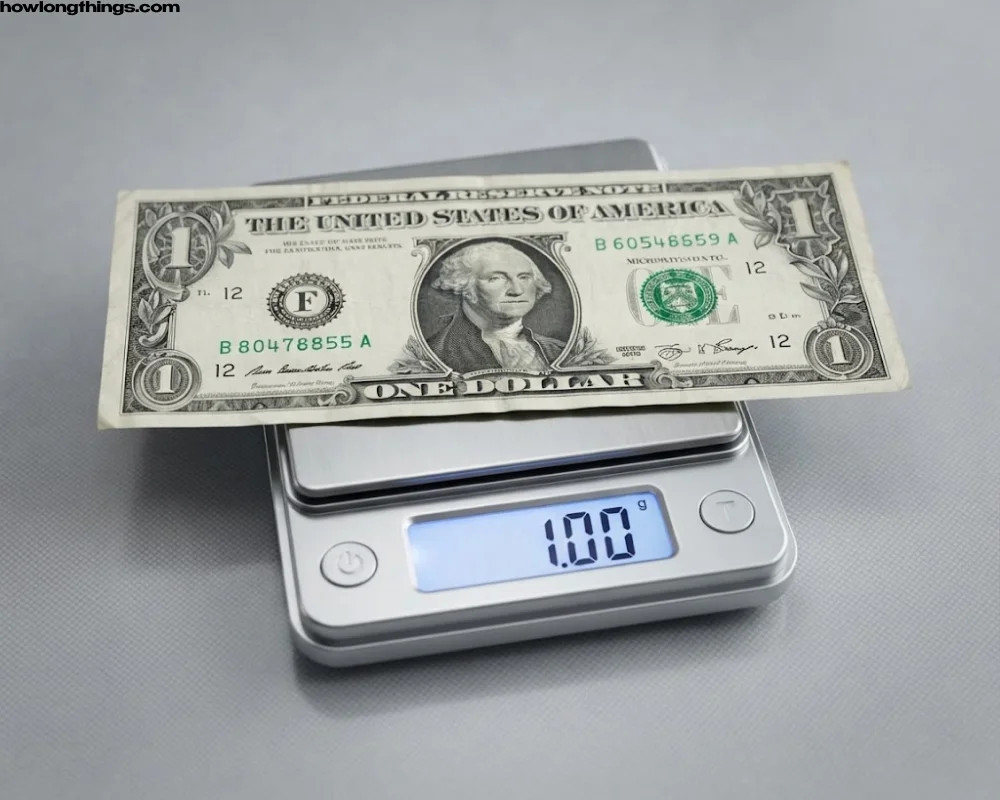
The thickness comes in at about 0.0043 inches — roughly the width of a human hair times four. A single bill weighs close to 1 gram, which is why 454 crisp bills weigh almost exactly one pound.
Here’s the quick breakdown:
Length: 6.14 inches (155.956 mm)
Width: 2.61 inches (66.294 mm)
Thickness: 0.0043 inches (0.11 mm)
Weight: ~1 gram
The length-to-width ratio works out to about 2.35 to 1, often rounded to roughly 7:3. That proportion isn’t random — it’s close to a rectangle that feels balanced to the eye, and it’s stayed fixed since the size was standardized.
So, is a dollar bill 8 inches long? No. That’s a common guess, but it overshoots the real figure by almost two inches. At 6.14 inches, a dollar bill is shorter than a standard No. 10 envelope and shorter than most smartphones laid flat.
One detail people miss: dollar bills aren’t made from wood-pulp paper at all. The material is a blend of 75% cotton and 25% linen. That’s what gives the bill its unique texture and lets it survive folding, washing machines, and years of handling without falling apart.
Here’s a fact that surprises a lot of people: every US bill is the same physical size. A $1 bill and a $100 bill measure identically — 6.14 inches by 2.61 inches, no exceptions.
What is the exact size of a $100 bill? Exactly 6.14 inches long and 2.61 inches wide — the same as every other denomination. The only differences are the printed design, security features, and color-shifting ink.
How wide is a $20 bill in inches? 2.61 inches, same as the rest.
How many inches is a $10 bill? 6.14 inches long, 2.61 inches wide — again, identical to every other bill.
This uniform sizing is deliberate. It means:
ATMs and vending machines don’t need separate settings per denomination
Counterfeit detectors can flag anything outside the standard tolerance instantly
Wallets, cash drawers, and money-counting machines work across all bills without adjustment
What actually changes between denominations is the security architecture — the placement of the security thread, the portrait, the watermark position, and the color-shifting ink used on $10 bills and higher. The paper itself never moves.
Dollar Bill Dimensions in Inches, CM, and MM (Conversion Chart)
If you’re designing a template, building a display case, or just converting units, here’s the full breakdown:
Measurement
Inches
Centimeters
Millimeters
Length
6.14 in
15.6 cm
155.96 mm
Width
2.61 in
6.63 cm
66.29 mm
Thickness
0.0043 in
0.011 cm
0.11 mm
Folded dimensions matter too, especially for wallet design or origami projects:
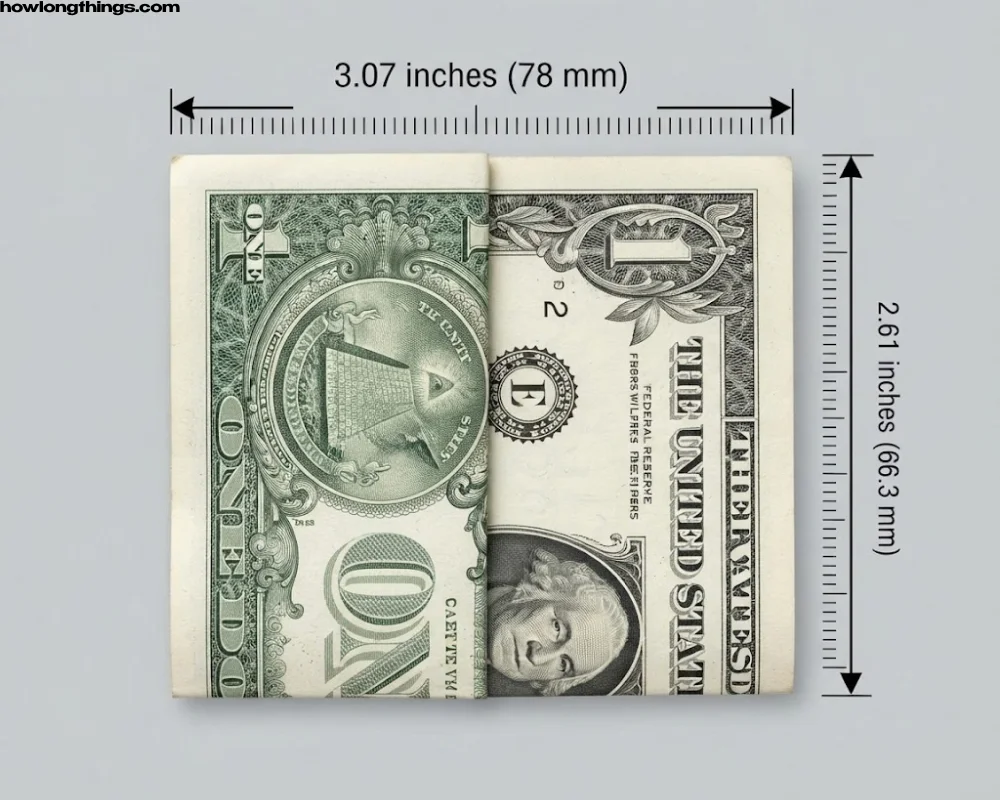
Folded in half (short way): 3.07 inches × 2.61 inches
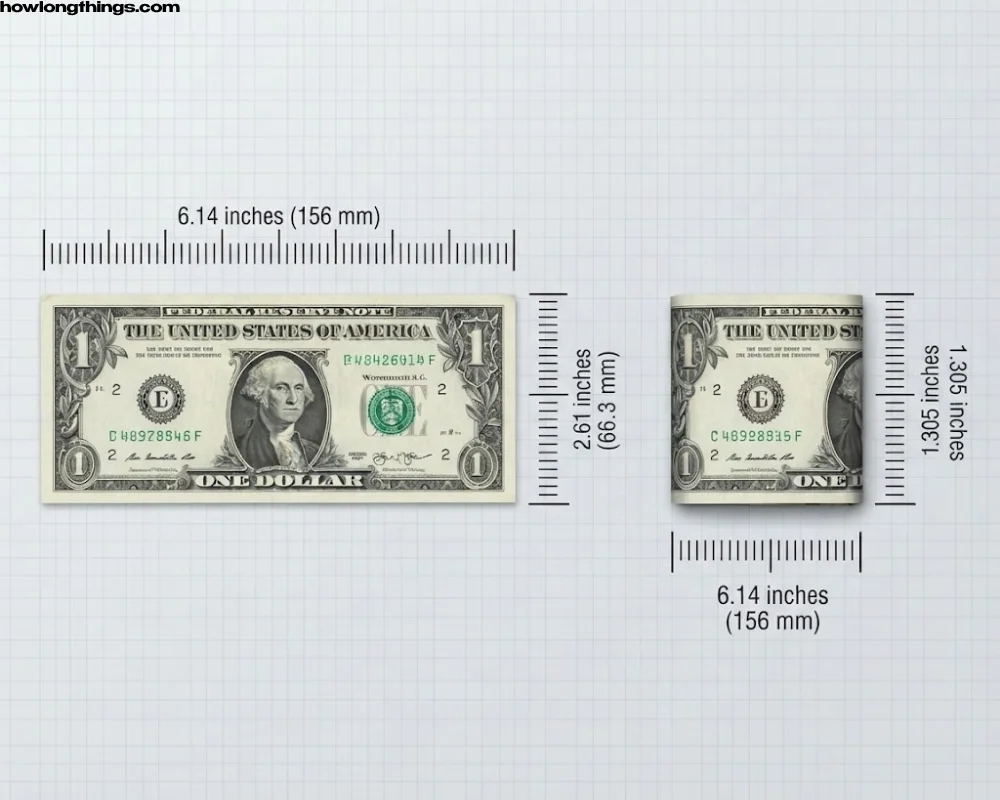
Folded in half (long way): 6.14 inches × 1.305 inches
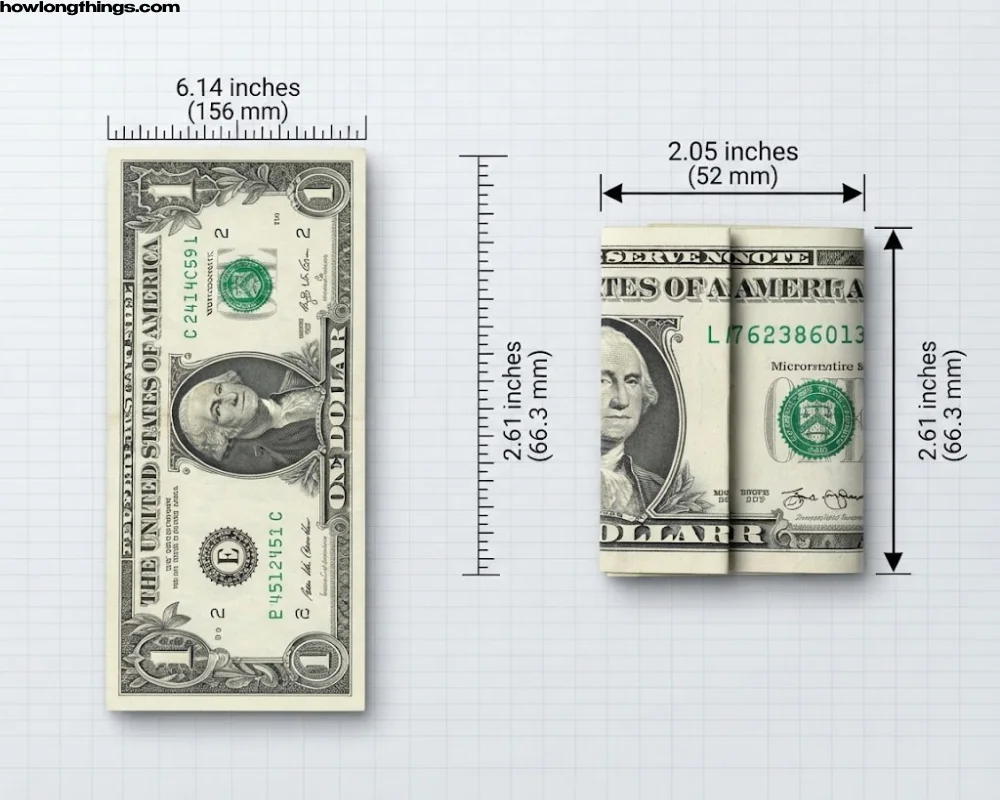
Tri-folded: roughly 2.05 inches × 2.61 inches
How much is 1 inch of $100 bill? Since a $100 bill is 6.14 inches long, one inch represents about 16.3% of its total length. It’s a simple proportion — useful if you’re scaling a design, cropping an image, or building a to-scale prop.
How Dollar Bill Size Has Changed Since 1861
Dollar bills weren’t always this compact. Before 1929, US currency was printed as “large-size” notes — nicknamed “horse blanket notes” by the public because of how oversized they felt in a pocket. Those bills measured about 7.42 inches by 3.13 inches, noticeably bigger in both directions.
The redesign to the modern size happened for practical reasons, not aesthetics. Smaller bills meant:
Lower printing costs, since less paper and ink went into each note
Easier handling in bank vaults, cash drawers, and adding machines
A better fit in standard wallets, which were shrinking to match pocket sizes of the era
The change rolled out in 1929, and the dimensions haven’t shifted since. Every bill printed for nearly a century has followed the same 6.14 by 2.61-inch standard — a rare example of a government specification staying untouched for generations.
Why Dollar Bill Dimensions Matter in Everyday Life
This isn’t just trivia. The exact size of a dollar bill shapes products and systems you interact with regularly.
Wallets and cash organizers are built around the 6.14 by 2.61-inch standard. That’s why a bifold wallet has a specific pocket depth, and why a bill that’s been stretched or torn often won’t sit flush anymore.
Vending machines, ATMs, and bill counters rely on precise measurements to accept genuine currency and reject anything off-spec. A bill even a few millimeters outside tolerance gets kicked back — that’s the machine doing basic counterfeit screening.
Counterfeit detection at banks and retail counters also leans on size. Genuine currency paper has a distinct thickness and feel that’s hard to replicate, and machines cross-check physical dimensions alongside security threads and watermarks.
DIY and creative projects are another common reason people search for these specs — printable play money, movie props, currency display frames, and origami all depend on getting the proportions right. Knowing the real 6.14 by 2.61-inch ratio means the end result actually looks authentic instead of slightly “off.”
FAQs About Dollar Bill Dimensions
What is the dimension ratio of a US dollar bill?
The ratio is about 2.35 to 1, often rounded to roughly 7:3. This comes from dividing the length (6.14 inches) by the width (2.61 inches).
What is the exact size of a $100 bill?
A $100 bill measures 6.14 inches by 2.61 inches — identical to every other US denomination, from the $1 to the $100.
Is a dollar bill 8 inches long?
No. A dollar bill is 6.14 inches long, not 8 inches. This is one of the most common misconceptions about US currency size.
How wide is a $20 bill in inches?
A $20 bill is 2.61 inches wide, the same width shared by every US paper denomination.
How many inches is a $10 bill?
A $10 bill is 6.14 inches long and 2.61 inches wide, matching the standard size used across all denominations.
How much is 1 inch of $100 bill?
One inch equals about 16.3% of a $100 bill’s total length, since the full bill measures 6.14 inches long.
Final Thoughts
Every US bill, from the $1 to the $100, shares the exact same footprint: 6.14 inches by 2.61 inches. That consistency isn’t an accident — it’s what keeps ATMs, vending machines, and counterfeit detectors working smoothly across every denomination in circulation.
Elizabeth Queen is a Owner and consumer research writer at HowLongThings.com, specializing in product lifespan, durability, and everyday household research. She’s passionate about helping readers make smarter, longer-lasting buying decisions.