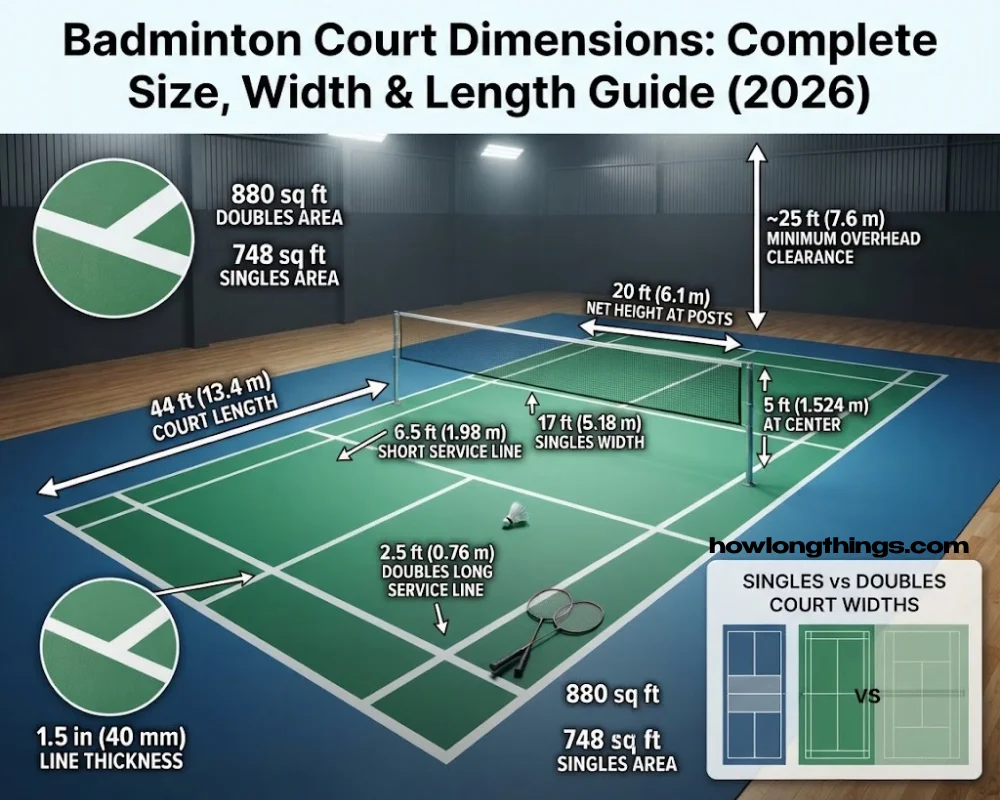
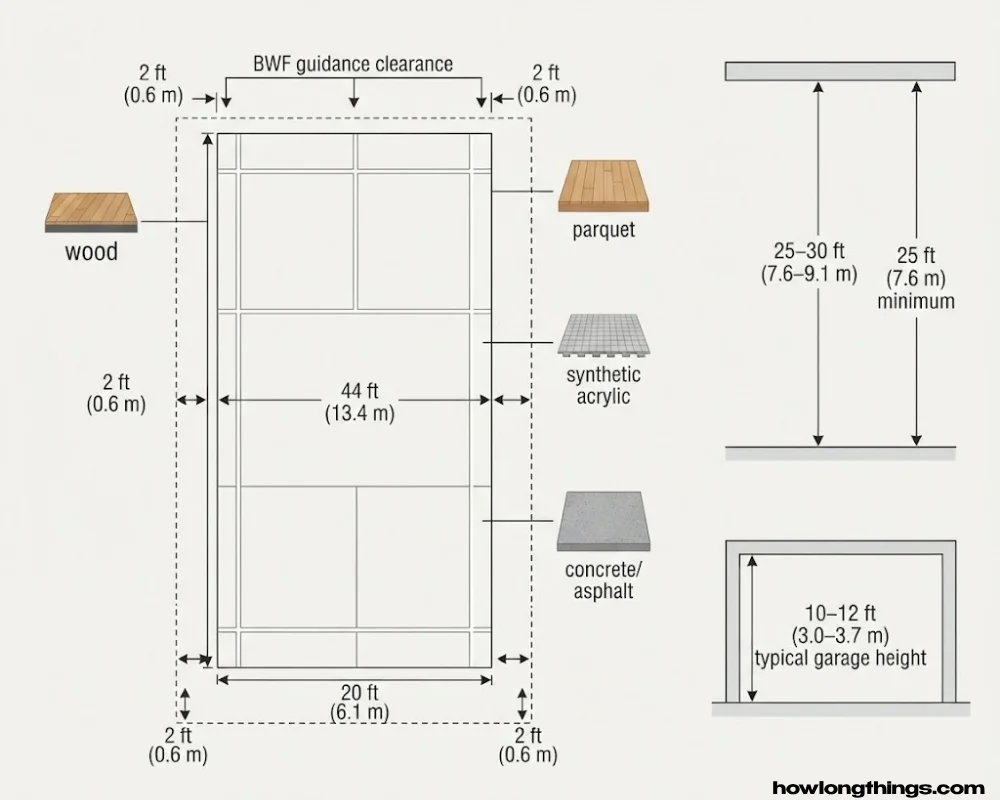
A standard badminton court measures 44 feet long and 20 feet wide for doubles, or 44 feet long and 17 feet wide for singles. Every measurement on the court, from the net to the service lines, is locked in by the Badminton World Federation (BWF), so the court you play on in a school gym is the same size as the one used at the Olympics.
Table of Contents
What Are the Official Badminton Court Dimensions?
The Laws of Badminton set the official badminton court dimensions, and they don’t change no matter where you play in the world.
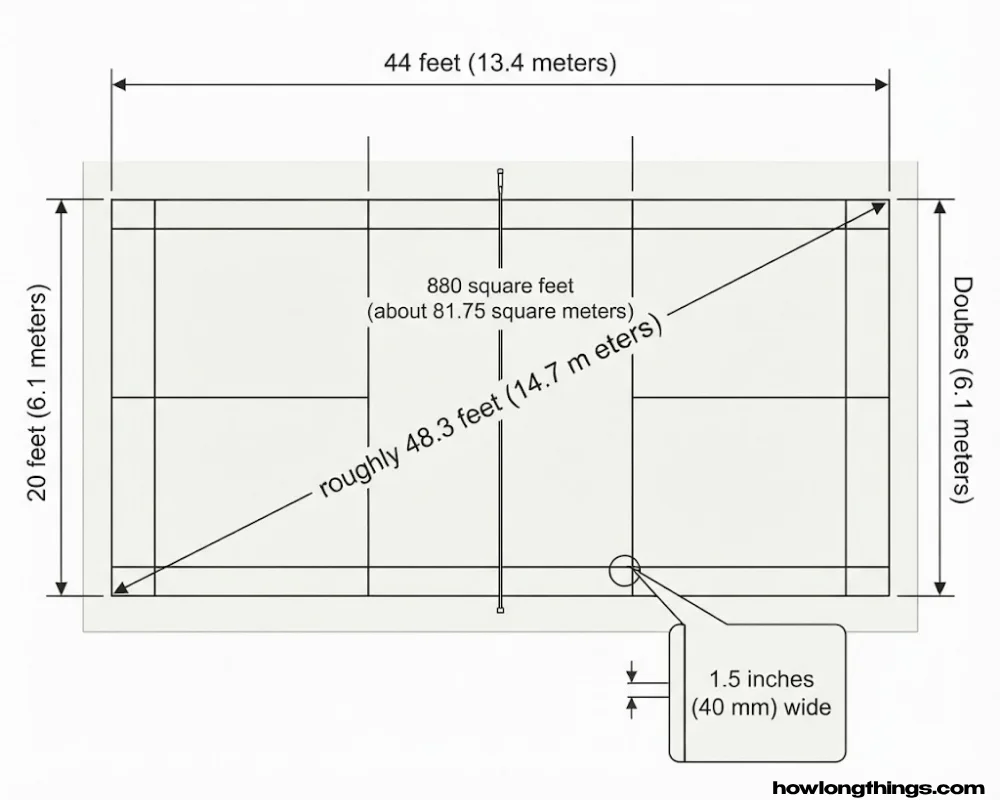
A full badminton court size is 44 feet (13.4 meters) long. That length stays the same whether you’re playing singles or doubles — only the width changes.
The doubles court width is 20 feet (6.1 meters). That gives a total playing surface of 880 square feet (about 81.75 square meters).
The court also has a diagonal length of roughly 48.3 feet (14.7 meters), which comes in handy if you’re squaring off the corners while marking a court yourself.
Quick fact: all lines on a badminton court are 1.5 inches (40 mm) wide, painted white or yellow so they stand out clearly against the floor.
Easy Badminton Court Measurements at a Glance
Here’s every key badminton court measurement in one simple table, so you don’t have to hunt through the article for a number.
Badminton Court Size: Singles vs Doubles Width Explained
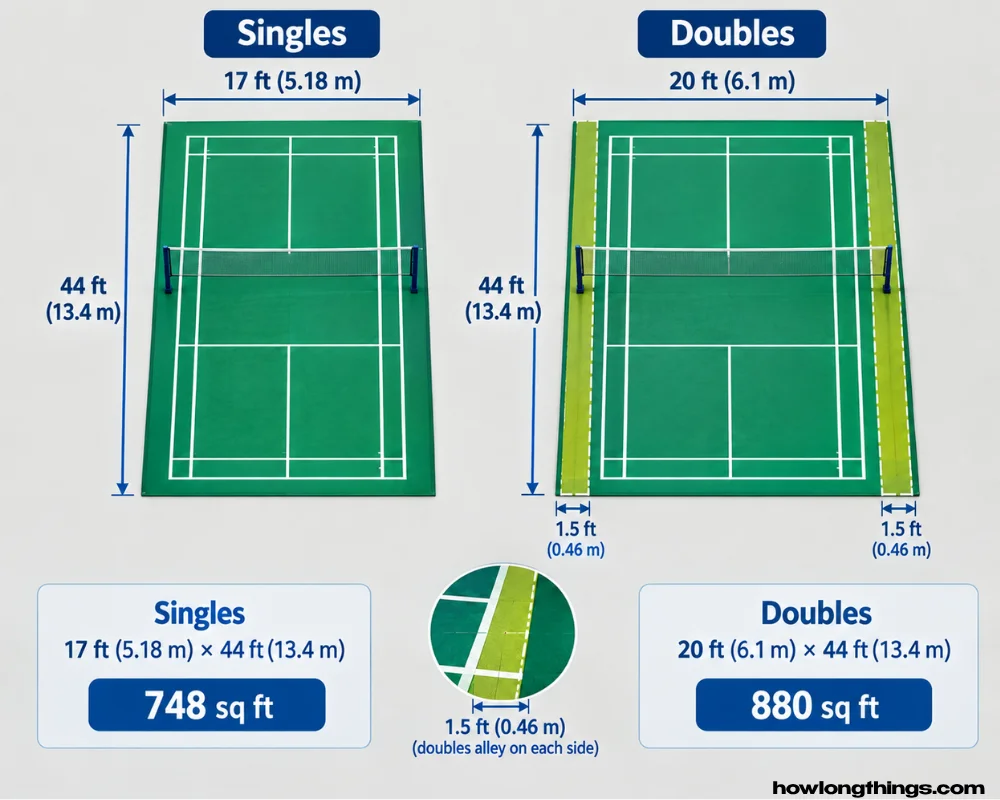
This is where most people get confused. The badminton court width isn’t one fixed number — it depends on whether you’re playing singles or doubles.
For doubles, players use the full 20 foot (6.1 m) width. For singles, the court narrows to 17 feet (5.18 meters).
That difference comes from the doubles alley (technically called the doubles sideline), a 1.5 foot (0.46 m) strip running along each side of the court. Doubles teams use it because they have two players covering more ground. Singles players don’t need it, so the sideline cuts inward.
Here’s the part that trips people up: the court length never changes. A singles match and a doubles match are both played on a court that’s 44 feet long. Only the width shrinks or expands.
Format
Length
Width
Area
Singles
44 ft (13.4 m)
17 ft (5.18 m)
748 sq ft
Doubles
44 ft (13.4 m)
20 ft (6.1 m)
880 sq ft
Badminton Court Layout: Lines, Service Courts & Net Height
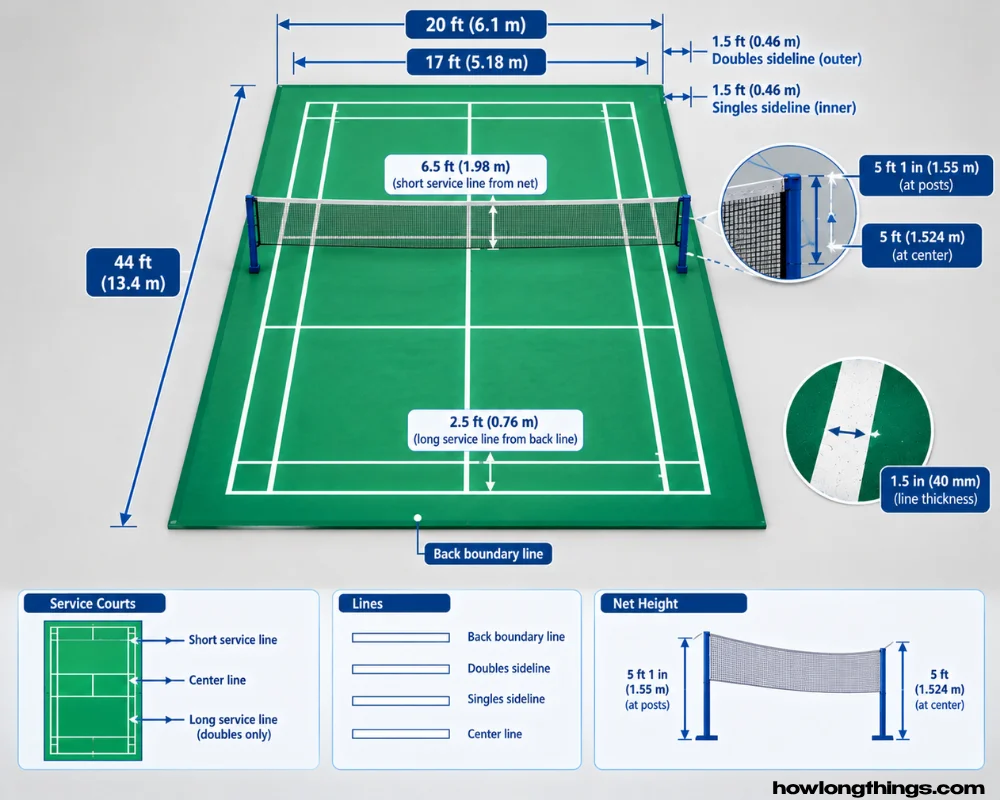
Once you know the outer badminton court dimensions, the next step is understanding what’s inside them. Every court is broken into zones by a series of lines, and each one has a specific job.
Working from the outside in: the back boundary line marks the very end of the court (it also doubles as the long service line for singles). The doubles sideline is the outermost width line. Move 1.5 feet inward and you hit the singles sideline. Down the middle of the court, the center line splits each side into left and right service boxes.
Then there’s the short service line, sitting 6.5 feet (1.98 meters) from the net on each side. A serve that doesn’t clear this line is a fault — it’s the zone that keeps short serves honest.
Doubles adds one more: the long service line, positioned 2.5 feet (0.76 meters) inside the back boundary. Serves in doubles can’t fly past this line either, which keeps doubles serves shorter and faster than singles serves.
The badminton net height matters just as much as the court markings. At the posts, the net sits at 5 feet 1 inch (1.55 m). At the center, where it naturally sags a little, it drops to 5 feet (1.524 m). That half-inch dip is intentional — it’s built into the rules, not a sign of a poorly strung net.
Getting the court markings right is only half the job. Overhead clearance is the detail most backyard and home setups get wrong.
A well-struck overhead clear can send the shuttlecock 25 to 30 feet into the air. If your ceiling is lower than that — a typical garage sits around 10 to 12 feet — you physically cannot play a full, proper clear shot. For recreational play, aim for a minimum ceiling height of around 25 feet; competitive venues push closer to 30 feet or more.
Space around the court matters too. BWF guidance calls for at least 2 feet (0.6 m) of clearance on all sides of the court boundary, so players have room to lunge, dive, and recover without slamming into a wall.
Flooring is the other piece worth getting right. Indoor competitive courts typically use wood or synthetic acrylic surfaces, both chosen for shock absorption and grip. Casual and backyard setups often use PVC interlocking tiles or simply play on an existing gym or driveway surface, marking the lines with tape or chalk.
Badminton Court Size vs Other Racket Sports
People searching for badminton court dimensions often want to know how it stacks up against other racket sports, especially pickleball, since interest in that sport has grown fast in the US.
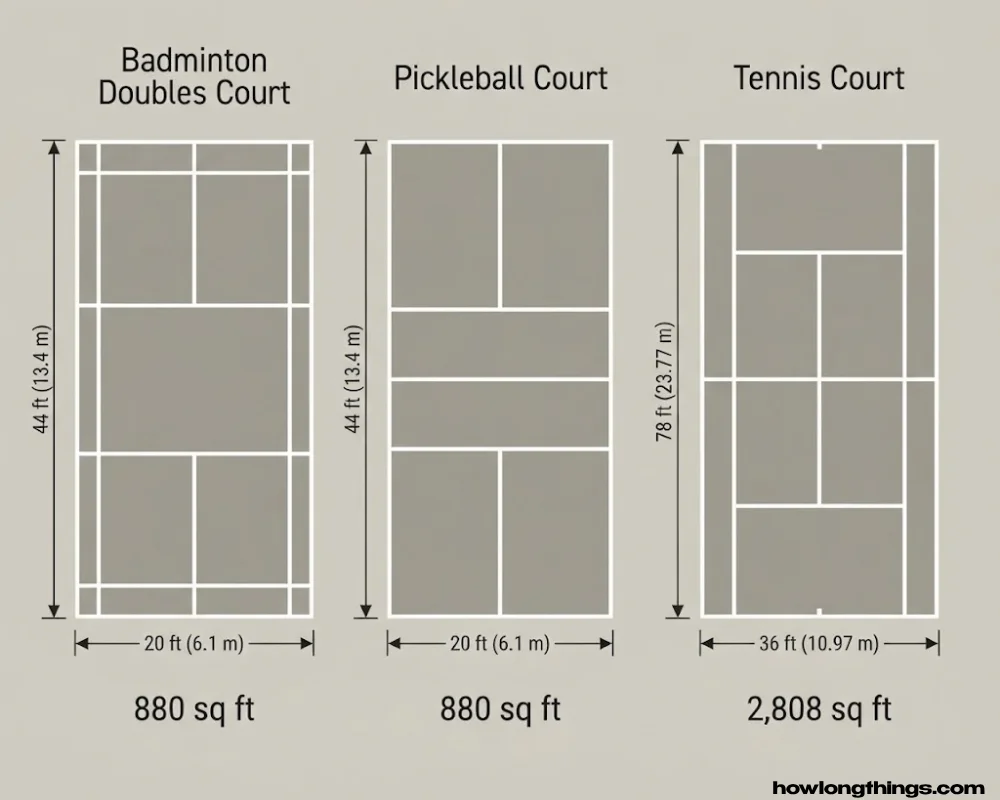
A pickleball court is smaller in play area — its total footprint (44 ft by 20 ft) happens to match a doubles badminton court, but the two sports use different net heights, different serving rules, and different surfacing, so a badminton court can’t simply be repainted with pickleball lines without adjustment.
A tennis court, by comparison, is far larger — 78 feet long, nearly double a badminton court’s length. That’s why badminton facilities can fit comfortably inside a standard gymnasium while tennis needs a dedicated outdoor or domed space.
FAQs About Badminton Court Dimensions
Is a badminton court 20 feet by 44 feet?
Yes, for doubles. A doubles badminton court is 20 feet wide by 44 feet long. A singles court uses the same 44-foot length but narrows to 17 feet wide.
Is pickleball court size the same as badminton?
Not exactly. A pickleball court’s total footprint (44 ft by 20 ft) matches a doubles badminton court, but the two sports have different net heights, service areas, and line markings, so the courts aren’t interchangeable without re-marking.
What is badminton net height?
The net height is 5 feet 1 inch (1.55 m) at the posts and 5 feet (1.524 m) at the center, where the net naturally dips slightly.
What is the minimum height required for a badminton court?
Most guidance recommends a minimum ceiling clearance of around 25 feet for recreational play, since a full overhead clear can send the shuttlecock 25 to 30 feet high. Competitive venues often require even more overhead space.
What are 5 rules in badminton?
Five core rules: the shuttlecock must be hit over the net into the opponent’s court; the shuttlecock can only be struck once per side before crossing the net; it cannot touch the floor during play; a serve must be hit underhand and below the server’s waist; and points are scored on every serve, with games typically played to 21 points.
What is the perfect height for badminton?
For the net, the “perfect” height is the official standard: 5 feet at the center, 5 feet 1 inch at the posts. There’s no separate official standard for player height — badminton is played competitively by athletes of many different heights.
Conclusion
Whether you’re building a home court, setting up a gym, or just settling an argument about the rules, these badminton court dimensions are the numbers that matter: 44 feet long, 20 feet wide for doubles, 17 feet wide for singles. Get those right, add proper clearance overhead, and you’ve got a court that plays exactly like the pros use.
Elizabeth Queen is a Owner and consumer research writer at HowLongThings.com, specializing in product lifespan, durability, and everyday household research. She’s passionate about helping readers make smarter, longer-lasting buying decisions.