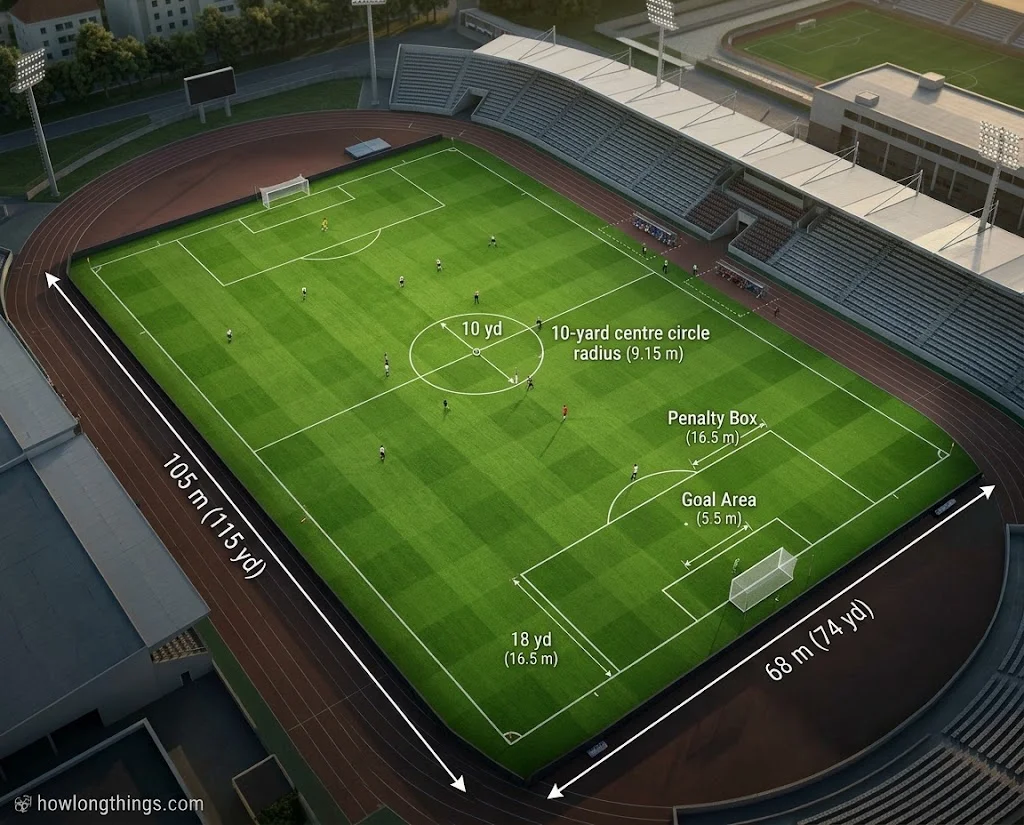
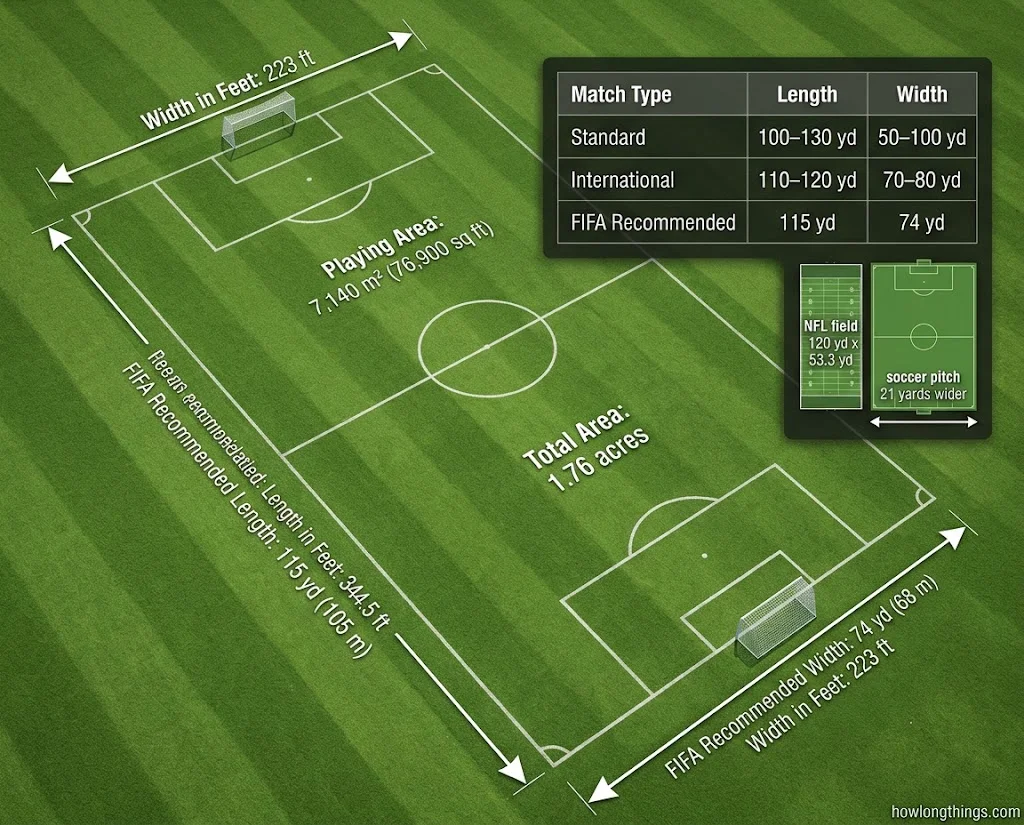
A standard soccer pitch size is 115 x 74 yards (105 x 68 meters). That is the size FIFA recommends for major matches. It covers about 1.76 acres.
Still, soccer field dimensions are not fixed. The size changes with age, league and level of play. This guide covers sizes in yards, meters and feet. It also explains the pitch markings and the space around the pitch.
Table of Contents
Standard Soccer Pitch Size in Yards, Meters and Feet
The IFAB Laws of the Game set a range, not one number. Under Law 1, the touchline must be longer than the goal line.
Match type
Length
Width
Standard (all matches)
100–130 yd (90–120 m)
50–100 yd (45–90 m)
International matches
110–120 yd (100–110 m)
70–80 yd (64–75 m)
FIFA recommended size
115 yd (105 m)
74 yd (68 m)
In feet
344.5 ft
223 ft
The recommended pitch covers 7,140 square meters. That is about 76,900 square feet, or 1.76 acres.
Why is there a range? Soccer grew on open ground, long before modern stadiums. The rules kept that flexibility. A competition can pick its own size inside the legal limits.
Here is how the standard soccer pitch size stacks up against other fields:
NFL field: 120 yards long and 53.3 yards wide. A soccer pitch is about 21 yards wider.
Surface: Law 1 allows a fully natural or fully artificial playing surface, if the competition permits it. Many top pitches use hybrid grass, which has synthetic fibers stitched into natural turf.
Men’s and women’s pitches: The size rules are the same.
Just as accurate measurements matter when marking a soccer pitch, precise dimensions are equally important when collecting and organizing trading cards. If you enjoy comparing sizes and understanding exact measurements, explore this helpful guide to standard Pokémon card dimensions and sizes to learn how they compare across different card types.
Soccer Pitch Dimensions by Age, League and Format
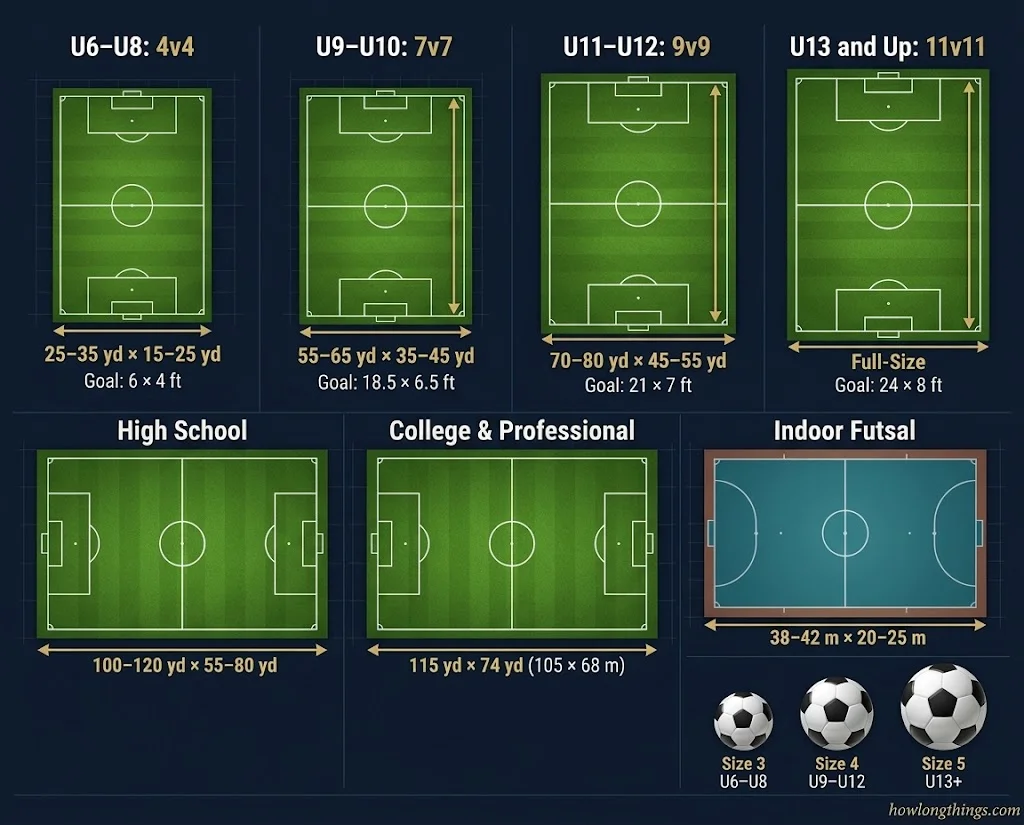
Young players use smaller pitches. This keeps the game fast and fair. US Soccer and US Youth Soccer set small-sided standards for ages U6 to U12.
Age group
Format
Pitch size
Max goal size
U6–U8
4v4
25–35 x 15–25 yd
6 x 4 ft
U9–U10
7v7
55–65 x 35–45 yd
18.5 x 6.5 ft
U11–U12
9v9
70–80 x 45–55 yd
21 x 7 ft
U13 and up
11v11
Full size
24 x 8 ft
Older players move to the full-size pitch. Here is how the main US levels compare:
High school (NFHS): about 100–120 yards long and 55–80 yards wide.
College and pro: most use the FIFA-style 115 x 74 yards.
Futsal and indoor: much smaller. A futsal court is about 38–42 meters long and 20–25 meters wide.
Ball size also changes with age. Younger players use a size 3 or 4 ball. From U13, players use a size 5.
Quick tip: A US park often shares space with a football field or a running track. Measure the width first. Width is usually the limit, not length.
Soccer Pitch Markings and Space Around the Pitch Explained
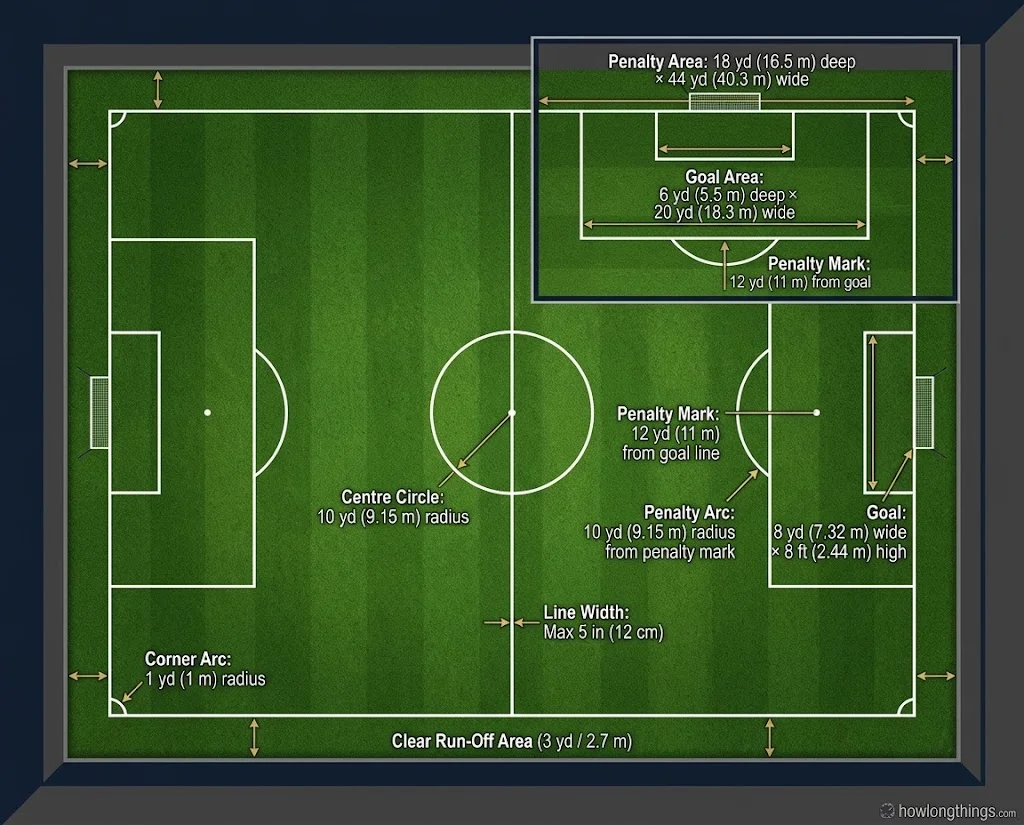
Every line on the pitch is part of the field of play. Lines must be the same width, and no more than 5 inches (12 cm) wide. FIFA also requires the pitch to be rectangular, with continuous lines.
Marking
Size
Penalty area (18-yard box)
18 yd (16.5 m) deep, 44 yd (40.3 m) wide
Goal area (six-yard box)
6 yd (5.5 m) deep, 20 yd (18.3 m) wide
Penalty mark
12 yd (11 m) from the goal line
Penalty arc (the D)
10 yd (9.15 m) radius from the penalty mark
Centre circle
10 yd (9.15 m) radius
Corner arc
1 yd (1 m) radius
Goal
8 yd (7.32 m) wide, 8 ft (2.44 m) high
The pitch also needs corner flagposts at all four corners. Flagposts on the halfway line are optional.
Space around the pitch matters too. This run-off area keeps players safe. The English FA suggests about 3 yards (2.7 m) on every side. Keep it clear of benches, barriers and lights. Stadiums also mark a technical area for coaches and substitutes.
How to mark out a pitch:
Use a measuring wheel or a long tape.
Pin the corners with stakes and string.
Check both diagonals. They must match, or the corners are not square.
Mark the lines with line marking paint and a wheel marker.
Soccer Pitch Dimensions FAQs
What is the size of a standard soccer pitch?
A standard soccer pitch measures 115 x 74 yards (105 x 68 meters). The legal range is 100–130 yards long and 50–100 yards wide. International matches must stay between 110–120 yards long and 70–80 yards wide.
Are all pitches on FIFA the same size?
No. The Laws of the Game allow a range of sizes. FIFA only recommends 105 x 68 meters. Its big tournaments, like the World Cup, use that size. Smaller leagues can use any size inside the legal limits.
What is the size of a Premier League pitch?
Most Premier League pitches are 105 x 68 meters. The Premier League’s pitch rules set that size unless the Board allows a change. Old Trafford, the Etihad, Emirates Stadium and Tottenham Hotspur Stadium all use it. A few older grounds, like Stamford Bridge, run slightly shorter at about 103 x 68 meters.
What is the pitch size for the 2026 World Cup?
Every venue used 105 x 68 meters, the same as the FIFA standard. All 11 US venues are NFL stadiums, so many had to widen their fields. The World Cup also required natural grass, so artificial turf was replaced. MetLife Stadium planned to remove 1,740 seats to fit the wider pitch.
What is the smallest stadium in the 2026 World Cup?
Toronto Stadium (BMO Field) was the smallest venue. Temporary stands raised its capacity to about 45,000. Its normal capacity is near 28,000.
Conclusion
The standard soccer pitch is 115 x 74 yards (105 x 68 meters). The rules allow a wider range, and youth formats use smaller pitches. The markings and run-off space are set by the Laws of the Game.
Before you mark out a pitch, check your league’s rules. Then measure twice and check the diagonals.
Elizabeth Queen is a Owner and consumer research writer at HowLongThings.com, specializing in product lifespan, durability, and everyday household research. She’s passionate about helping readers make smarter, longer-lasting buying decisions.