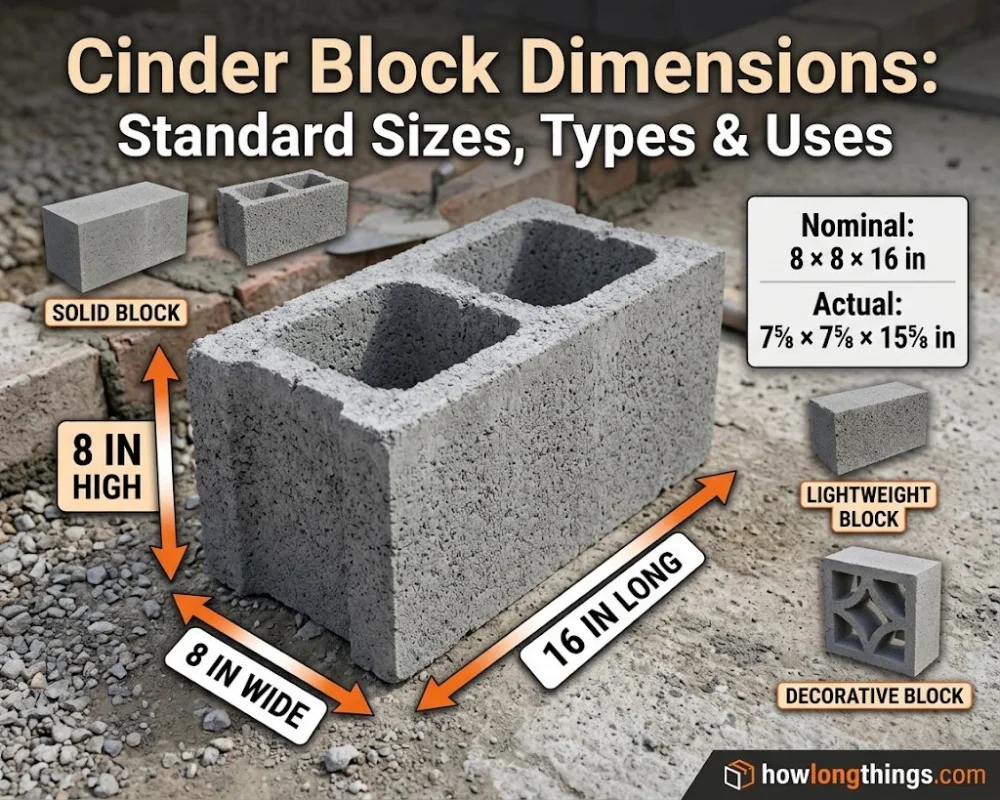
The standard cinder block dimensions are 8 x 8 x 16 inches nominal. In real life, the block measures 7 5/8 x 7 5/8 x 15 5/8 inches.
This guide covers cinder block sizes in inches and mm, holes, weight, strength, types, uses, and cost, so you can buy the right block the first time.
Table of Contents
Standard Cinder Block Dimensions (Nominal vs Actual)
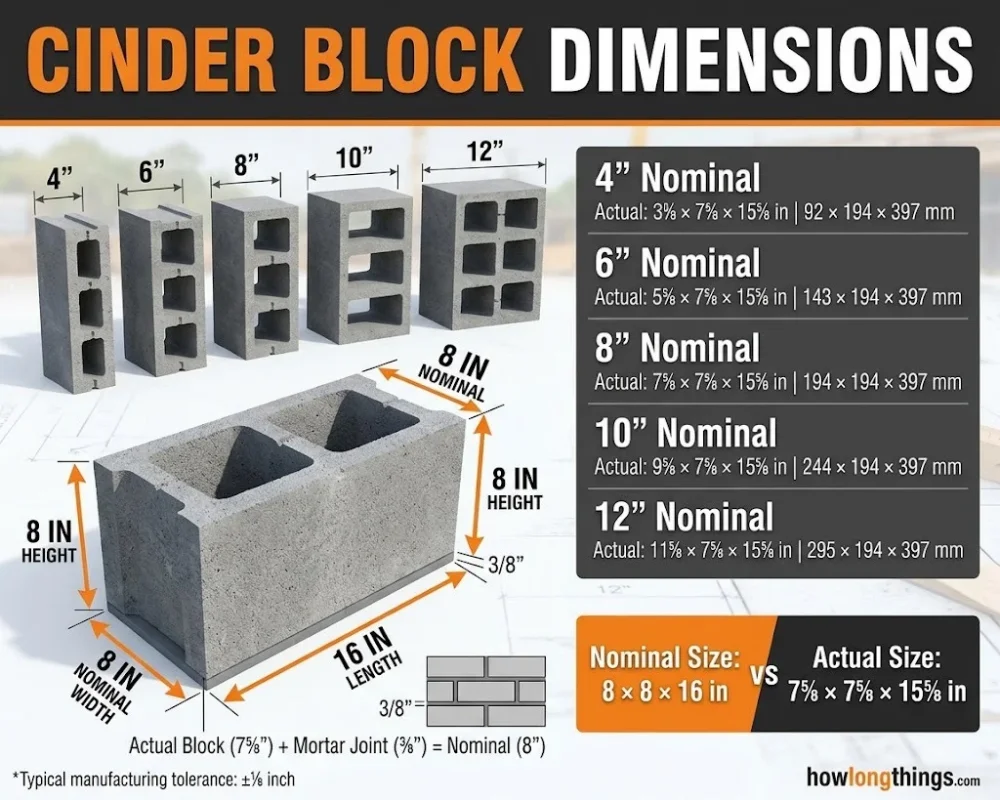
What is the standard size of a cinder block? The 8x8x16 cinder block is the standard. Its nominal size is 8 inches wide, 8 inches tall, and 16 inches long. Its actual size is 194 x 194 x 397 mm.
Why the gap? Nominal size includes the mortar joint, which is about 3/8 inch. So each side of the actual block is 3/8 inch smaller. Manufacturing tolerance is about plus or minus 1/8 inch.
The name reads width x height x length. A “6x8x16” block is 6 inches wide, 8 inches tall, and 16 inches long. Here is the full cinder block size chart.
Nominal width
Actual size (in)
Actual size (mm)
4 in
3 5/8 x 7 5/8 x 15 5/8
92 x 194 x 397
6 in
5 5/8 x 7 5/8 x 15 5/8
143 x 194 x 397
8 in
7 5/8 x 7 5/8 x 15 5/8
194 x 194 x 397
10 in
9 5/8 x 7 5/8 x 15 5/8
244 x 194 x 397
12 in
11 5/8 x 7 5/8 x 15 5/8
295 x 194 x 397
Metric conversions use the exact rate of 25.4 mm per inch, per NIST. A half block is about 7 5/8 inches long. A half-high block is about 3 5/8 inches tall.
How many cinder blocks do you need per square foot? A full block covers 8 x 16 inches of wall face, or 128 square inches. Divide 144 by 128 and you get 1.125 blocks per square foot.
Block type
Blocks per sq ft of wall
Full height (8 x 16 in face)
1.125
Half-high (4 x 16 in face)
2.25
Two-footer (8 x 24 in face)
0.75
Height is easy to plan. Each course is 8 inches tall, so 12 courses make an 8-foot wall.
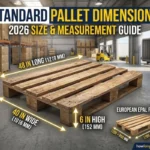
Just as choosing the right cinder block dimensions is essential for a successful construction project, selecting the correct pallet size helps ensure safe storage and efficient material transportation. Understanding standard pallet sizes and dimensions can help you plan warehouse space, organize building materials, and simplify shipping logistics.
Cinder Block Holes, Weight, and Strength
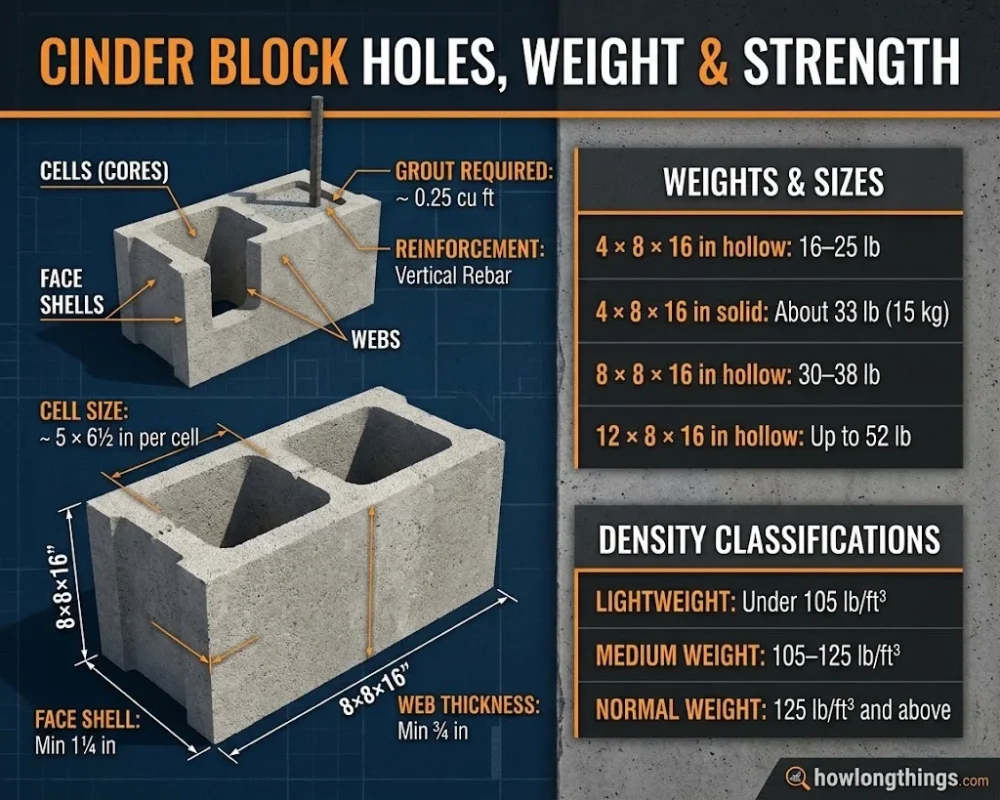
A standard hollow block has two large cavities, called cells or cores. They cut weight and let you add rebar and grout for a stronger wall.
How big are the holes? In an 8-inch block, each cell is roughly 5 by 6 1/2 inches. The walls around them are the face shells and the webs. Face shells run at least 1 1/4 inches thick in 8-inch blocks. Webs run at least 3/4 inch.
Filling the cores takes about 0.25 cubic feet of grout per 8-inch two-cell block. That is why grouted cores make walls far stronger.
How much does a cinder block weigh? It depends on width, density, and moisture. Density comes in three classes: lightweight (under 105 lb per cubic foot), medium weight (105 to 125), and normal weight (125 and up).
Block
Typical weight
4 x 8 x 16 hollow
About 16 to 25 lb
4 x 8 x 16 solid
About 33 lb (15 kg)
8 x 8 x 16 hollow
About 30 to 38 lb
12 x 8 x 16 hollow
Up to about 52 lb
How strong is a cinder block? Modern concrete masonry units (CMUs) must meet ASTM C90. It sets a minimum average net compressive strength of 2,000 psi, up from 1,900 psi in older editions, as Angelus Block explains.
Older true cinder blocks used coal cinders or ash. They are lighter, more porous, and generally weaker than concrete blocks. ASTM C129 covers lighter nonloadbearing units, made mainly for interior partitions.
Today, “cinder block” is mostly a nickname. Most blocks sold in the USA are cement and aggregate blocks.
Types of Cinder Blocks and CMU Shapes
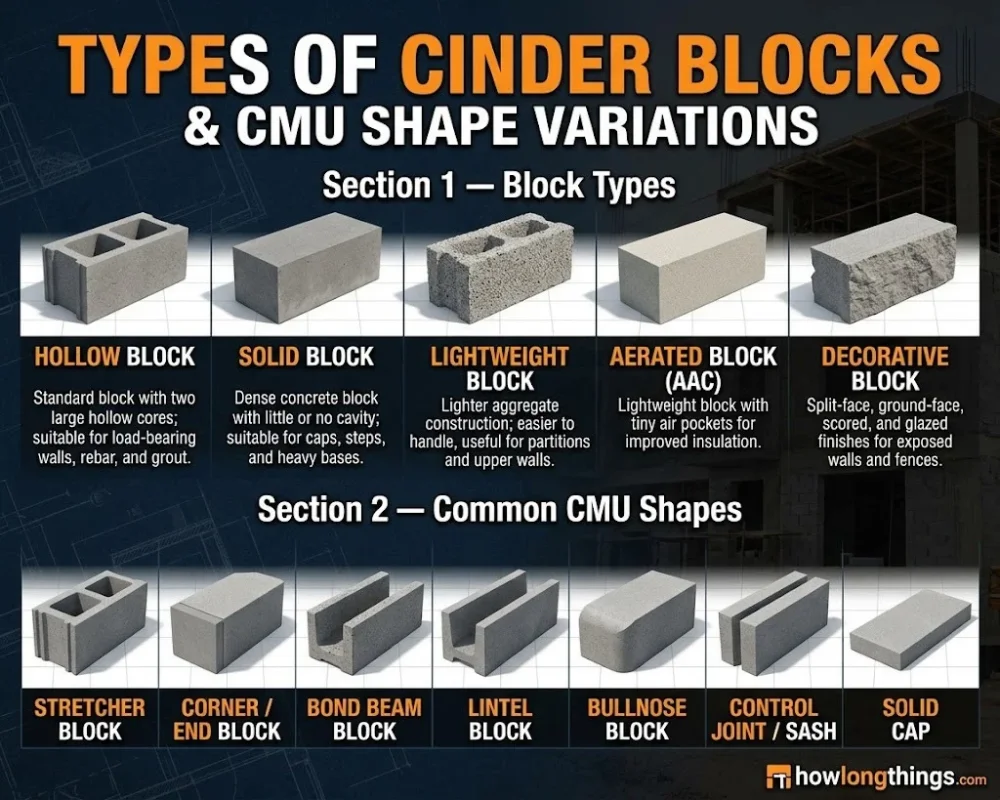
Blocks differ by core design, weight, and look. Pick by the job, not the name.
Hollow Blocks
Hollow blocks are the standard. They are lighter, easier to lay, and ready for rebar and grout. Most load-bearing walls use them.
Solid Blocks
Solid blocks have little or no cavity. They are heavier, stronger in compression, and better for caps, steps, and heavy bases.
Lightweight Blocks
Lightweight blocks use lighter aggregate. They cut lifting strain and improve insulation. They suit partitions and upper walls.
Aerated Blocks
Aerated blocks (AAC) hold tiny air pockets. They are very light and insulate well. They are less common in US foundations.
Decorative Blocks
Decorative blocks have a split-face, ground-face, scored, or glazed finish. They suit fences, garden walls, and exposed building faces.
Common Cinder Block Shapes
Stretcher: the standard block for wall runs.
Corner and end block: one flat end for clean edges.
Bond beam block: U-shaped, so it holds a horizontal rebar and grout.
Lintel block: spans doors and windows.
Bullnose block: rounded edge for exposed corners.
Control joint and sash block: handle cracking and window frames.
Solid cap: finishes the top of a wall.
Cinder Block Uses and How to Choose the Right Size
Match the block width to the load. Use this guide as a starting point, and always follow your local building code.
4-inch blocks: veneer, thin partitions, and garden edging.
6-inch blocks: interior walls and light partitions.
8-inch blocks: foundations, garages, and retaining walls.
10 to 12-inch blocks: tall walls and heavy load-bearing work.
DIY jobs work too. People build raised garden beds, shelves, and benches from blocks. Line any fire pit with firebrick, since heat can crack hollow blocks.
How many blocks do you need for a wall? Multiply the wall area in square feet by 1.125. Then add 5 to 10 percent for cuts and breaks.
Example: A wall is 20 feet long and 8 feet tall. That is 160 square feet. Multiply by 1.125 for 180 blocks. Add 5 percent and order about 190.
Blocks usually ship on pallets of about 70 to 90 for 8-inch units, depending on the supplier. A pallet can weigh around 3,000 pounds, so plan the forklift or truck delivery first.
Before you buy, check five things: the load, local code, fire rating, insulation and sound needs, and budget.
Cinder Block Dimensions FAQs
What is the standard size of a cinder block?
The standard size is 8 x 8 x 16 inches nominal. The actual size is 7 5/8 x 7 5/8 x 15 5/8 inches, or about 194 x 194 x 397 mm. The 3/8 inch difference is the mortar joint.
What are the standard dimensions of a cinder block hole?
In an 8-inch block, each cell measures roughly 5 by 6 1/2 inches. Face shells are at least 1 1/4 inches thick, and webs are at least 3/4 inch. Cell size shrinks in narrower blocks.
When did they stop using cinder blocks?
Cinder blocks fell out of favor after the mid-20th century. Cement and aggregate blocks took over because they are stronger and resist moisture better. The name stuck, so “cinder block” now usually means a CMU.
How much does a 4x8x16 cinder block weigh?
A hollow 4x8x16 block weighs about 16 to 25 pounds, depending on density. A solid one weighs about 33 pounds, or 15 kg.
Which is stronger, cinder block or concrete block?
Concrete block is stronger. True cinder blocks use coal ash, so they are lighter, more porous, and weaker. Modern concrete blocks must reach 2,000 psi net under ASTM C90.
How much does an 8x8x16 cinder block cost?
A standard hollow 8x8x16 block costs about $1.25 to $2.50 in 2026, based on Home Guide data. Solid blocks cost about $3.30 to $5.00. Pallets run roughly $115 to $225. Prices vary by region and supplier.
Final Thoughts
The standard cinder block dimensions are 8 x 8 x 16 inches nominal and 7 5/8 x 7 5/8 x 15 5/8 inches actual. Check width, weight, and strength before you buy, and match the block to your wall.
Elizabeth Queen is a Owner and consumer research writer at HowLongThings.com, specializing in product lifespan, durability, and everyday household research. She’s passionate about helping readers make smarter, longer-lasting buying decisions.