If you’ve ever squinted at a shelf trying to figure out why one soup can looks taller than another, you’re not alone. Soup can dimensions follow a set of industry standards that most shoppers never notice — but once you know them, meal planning, pantry storage, and even DIY projects get a lot easier.
This guide breaks down every common soup can size, from the classic condensed can to bulk food-service formats, so you know exactly what you’re working with before you open a can — or design a label for one.
Table of Contents
What Are Dimensions of soup can?
Soup can dimensions refer to three measurements: diameter (the width of the circular top), height (from the bottom rim to the top), and capacity (how much soup it holds, usually in fluid ounces).
The most recognizable soup can size in the U.S. is 3 inches in diameter by 4.5 inches tall, holding 10.5 to 10.75 ounces. This shape has barely changed in decades because it works — it stacks well, fits standard shelving, and runs smoothly through filling and sealing machines.
Standard Units of Measurement (Inches, CM, MM)
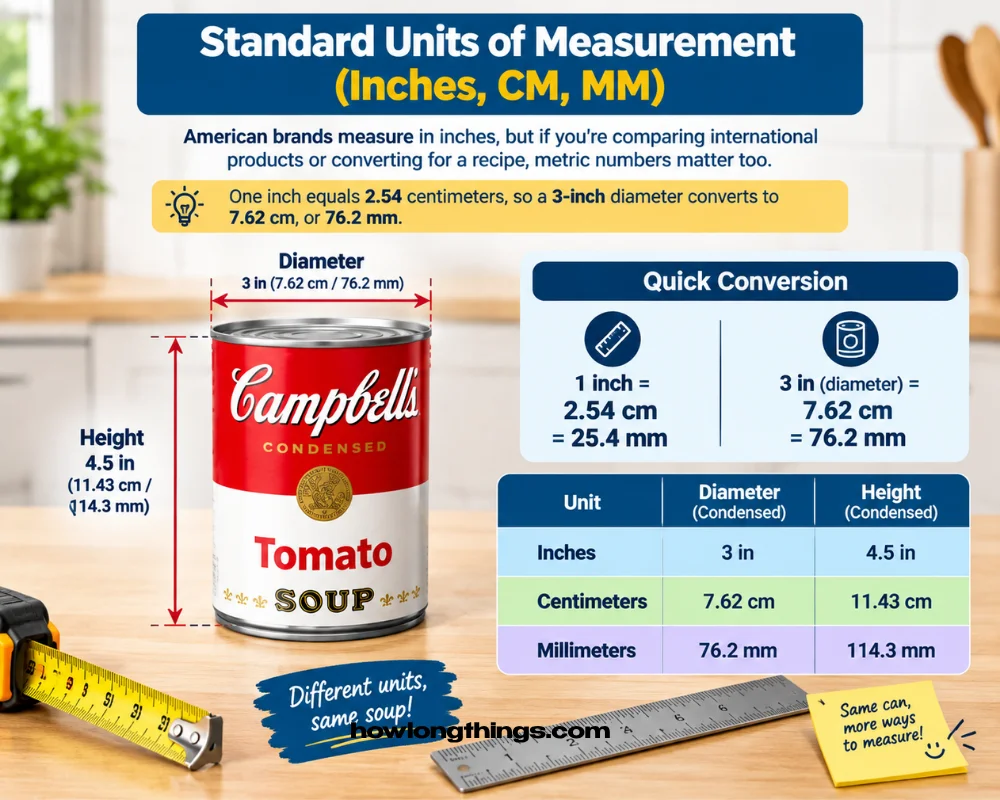
American brands measure in inches, but if you’re comparing international products or converting for a recipe, metric numbers matter too. One inch equals 2.54 centimeters, so a 3-inch diameter converts to 7.62 cm, or 76.2 mm.
| Unit | Diameter (Condensed) | Height (Condensed) |
|---|---|---|
| Inches | 3 in | 4.5 in |
| Centimeters | 7.62 cm | 11.43 cm |
| Millimeters | 76.2 mm | 114.3 mm |
Must Visit: Coke Can Dimensions: Complete Size, Height & Diameter Guide(2026)
Standard Soup Can Sizes & Complete Size Chart
Not every soup can is built the same way. The soup can height and diameter shift depending on whether the soup is concentrated, ready-to-eat, or packaged for a restaurant kitchen. Here’s how the main formats break down.
Condensed Soup Can Dimensions
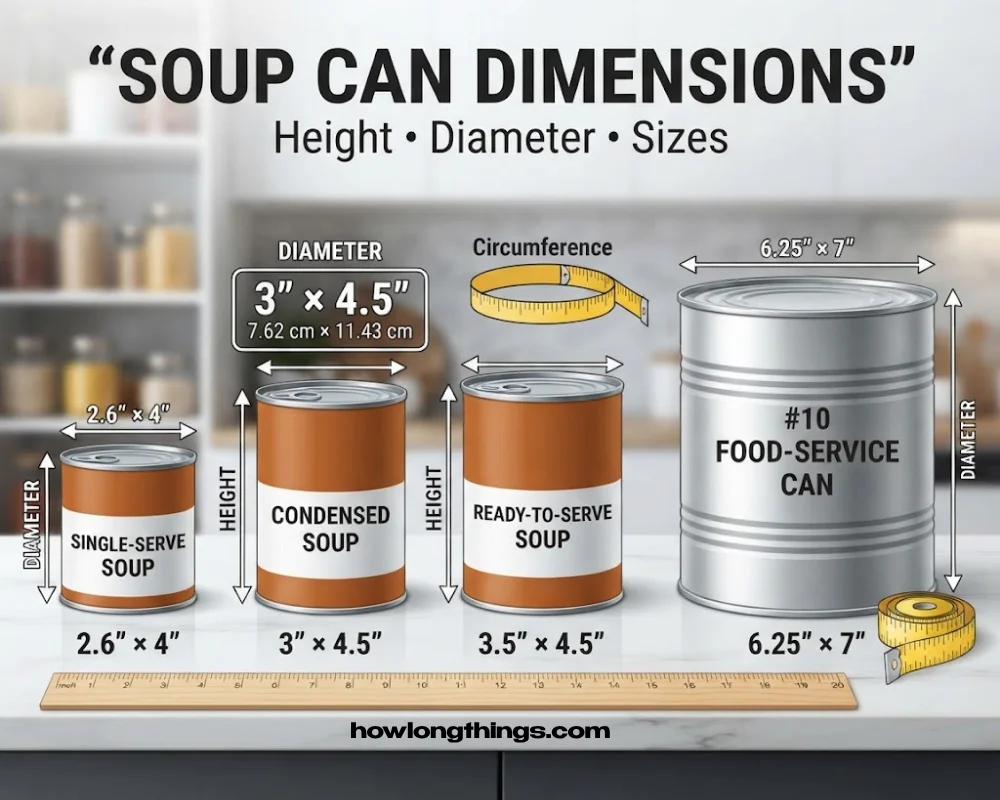
The condensed soup can dimensions you’ll see most often are 3 inches wide and 4.5 inches tall, holding 10.5 to 10.75 ounces. This is the format you dilute with water or milk before heating. The industry code for this size is #300, meaning the can is 3 inches in diameter — the “0” and remaining digits describe the height in sixteenths of an inch.
Because the soup is concentrated, one can typically stretches to about 2.5 cups once prepared — more than double what’s in the can itself.
Ready-to-Serve Soup Can Dimensions
Ready-to-serve (sometimes labeled “chunky”) cans are noticeably wider. Standard soup can dimensions here run 3.5 inches in diameter by 4.5 inches tall, holding 18 to 19 ounces. No water needed — this format is meant to be heated and eaten straight from the can. The wider body gives room for chunks of meat and vegetables that wouldn’t fit comfortably in a slimmer condensed can.
Small & Single-Serve Soup Can Dimensions
Individual-portion cans measure about 2.6 inches in diameter and 4 inches tall, holding roughly 7.25 ounces. These smaller soup can sizes are built for lunchboxes, dorm rooms, and anyone who wants a single serving without leftovers.
Large & Bulk Soup Can Dimensions
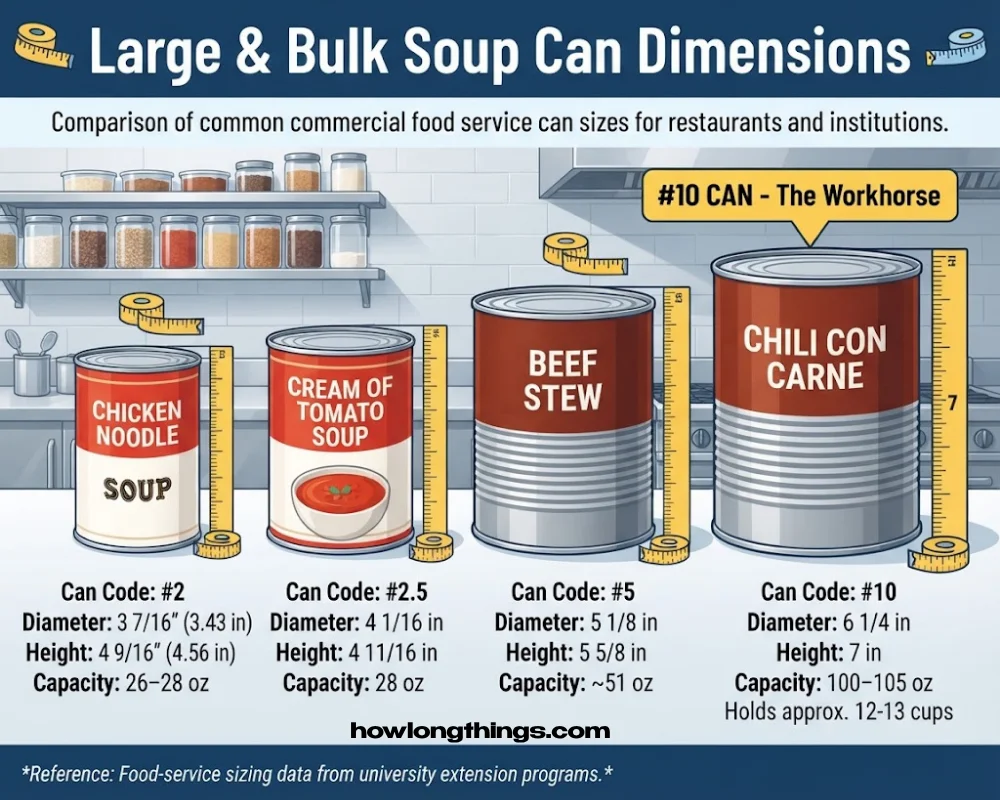
Restaurants, school cafeterias, and catering kitchens rely on much bigger formats:
| Can Code | Diameter | Height | Capacity |
|---|---|---|---|
| #2 | 5.4 in | 4.0 in | 26–28 oz |
| #2.5 | 4.01 in | 4.11 in | 28 oz |
| #5 | 5.125 in | 5.625 in | ~51 oz |
| #10 | 6.25 in | 7 in | 100–105 oz |
A #10 can — the workhorse of institutional kitchens — holds close to 12 to 13 cups of soup, according to food-service sizing references from university extension programs like Nebraska Extension’s guide to can-size numbers.
Soup Can Dimensions by Brand
Major soup brands stick to consistent measurements so their products fit standard shelving and consumer expectations. Together, a handful of household names account for the large majority of the U.S. canned soup market.
Campbell’s Soup Can Dimensions
Campbell’s condensed soup can dimensions measure 3 inches in diameter by 4.5 inches tall, holding exactly 10.75 ounces. This red-and-white can has kept nearly identical proportions since the 1960s — a rare case of packaging staying put while everything else in the grocery aisle has changed.
Campbell’s Chunky line, the ready-to-eat side of the brand, measures 3.5 inches wide by 4.5 inches tall, holding 18.6 to 19 ounces.
Progresso Soup Can Dimensions
Progresso cans run slightly wider than Campbell’s Chunky, at 3.375 inches in diameter and about 4.4 inches tall, holding 18.5 to 19 fluid ounces. That extra width gives a bit more room for larger vegetable pieces and heartier ingredients.
Amy’s, Heinz & Generic Store Brand Sizes
Amy’s Organic soups use BPA-free cans at 3 inches in diameter and 4.4 inches tall, holding 14.5 ounces. Heinz USA cans typically measure 3 inches wide by 4.43 inches high, holding 15 ounces. Store brands from major grocery chains generally mirror Campbell’s exact measurements — a deliberate choice that makes shelf swaps and price comparisons easy for shoppers.
| Brand | Diameter | Height | Volume |
|---|---|---|---|
| Campbell’s Condensed | 3 in | 4.5 in | 10.75 oz |
| Campbell’s Chunky | 3.5 in | 4.5 in | 18.6–19 oz |
| Progresso | 3.375 in | 4.4 in | 18.5–19 oz |
| Amy’s Organic | 3 in | 4.4 in | 14.5 oz |
| Heinz (USA) | 3 in | 4.43 in | 15 oz |
Soup Can Size Codes & Label Dimensions
This is where most guides stop short — but understanding can size codes and label dimensions matters just as much as knowing the can’s height.
How to Read Can Size Codes
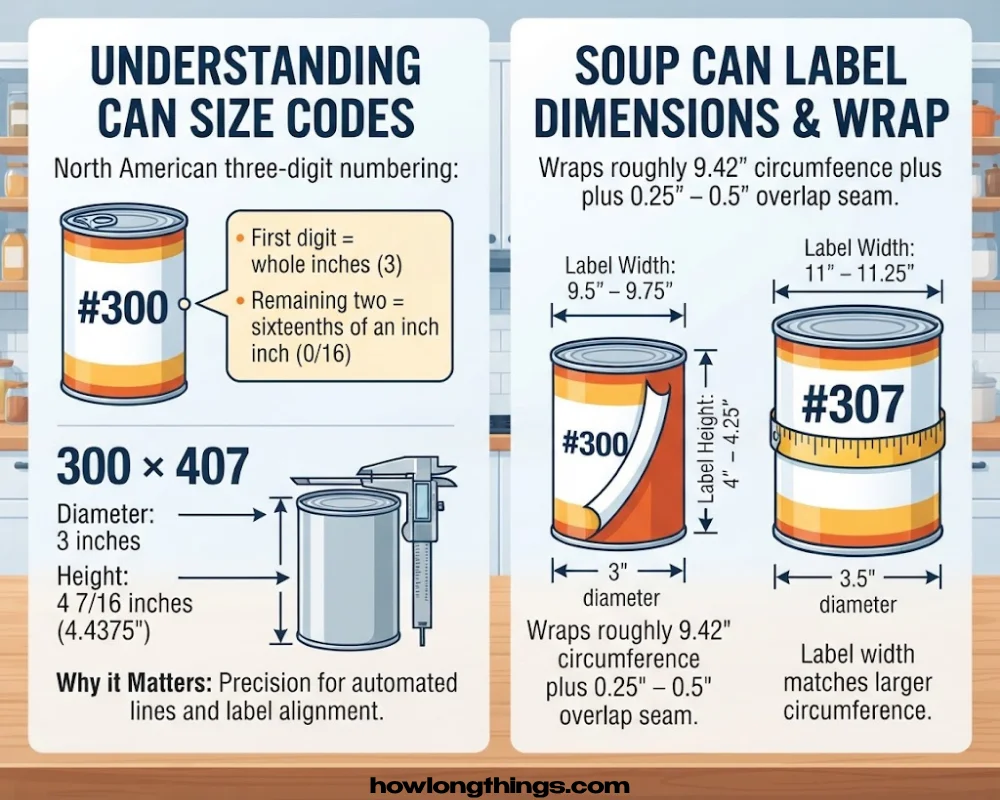
North American can manufacturers use a three-digit numbering system that’s been standard since the 1940s. The first digit represents whole inches, and the remaining two digits show sixteenths of an inch.
Take #300: that’s 3 and 0/16 inches, or exactly 3 inches in diameter. #307 works out to 3 and 7/16 inches, or 3.4375 inches. A full code combines both diameter and height — 300×407 means a can that’s 3 inches across and 4 7/16 inches tall (4.4375 inches).
This precision isn’t just trivia. Automated filling and seaming lines depend on it — even a 0.01-inch variance in a can’s dimensions can throw off a label alignment or cause a sealing failure at high production speeds.
Standard Soup Can Label Dimensions
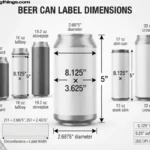
Soup can label dimensions are built to wrap the full circumference of the can, minus a small overlap seam (usually around 0.25 to 0.5 inches) where the two edges of the label meet.
For a standard #300 condensed can (3-inch diameter), the label typically measures about 9.5 to 9.75 inches wide — enough to wrap the can’s roughly 9.42-inch circumference plus overlap — and around 4 to 4.25 inches tall, leaving a small margin at the top and bottom rims.
For a #307 ready-to-serve can (3.5-inch diameter), label width runs closer to 11 to 11.25 inches, matching that can’s larger circumference.
Why Label Size Depends on Circumference
Because a can is cylindrical, its label isn’t measured like a flat rectangle sitting on a shelf — it’s measured to match how far around the can actually is. That’s why the standard dimensions of a can label always trace directly back to the can’s diameter. Change the diameter, and the label width has to change with it.
Soup Can Circumference, Volume & Metric Conversions
Numbers are more useful when you can see how they’re calculated, not just quoted. Here’s the actual math behind the measurements above.
How to Calculate Soup Can Circumference
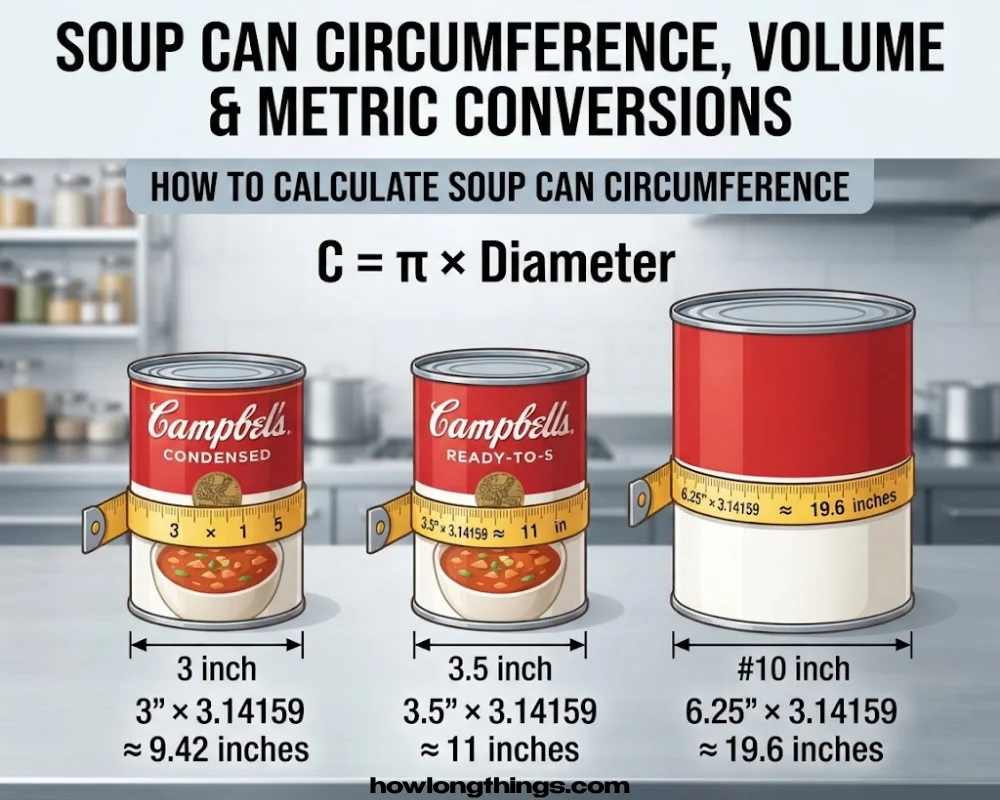
Circumference uses a simple formula: C = π × diameter.
For a standard 3-inch condensed can: 3 × 3.14159 ≈ 9.42 inches.
For a 3.5-inch ready-to-serve can: 3.5 × 3.14159 ≈ 11 inches.
A #10 bulk can, at 6.25 inches across, comes out to roughly 19.6 inches around — useful to know if you’re calculating shelf spacing or label material.
Calculating Volume & Capacity
Volume follows the cylinder formula: V = π × r² × height, where r is the radius (half the diameter).
For a 3-inch diameter can, the radius is 1.5 inches. Plugging that into a 4.5-inch-tall can:
3.14159 × (1.5)² × 4.5 ≈ 31.8 cubic inches
Convert that to fluid ounces and you land right around 10.75 fl oz — matching what’s printed on the label almost exactly.
Soup Can Dimensions in Centimeters & Millimeters
| Imperial | Metric |
|---|---|
| 3 in diameter | 7.62 cm / 76.2 mm |
| 4.5 in height | 11.43 cm / 114.3 mm |
| 3.5 in diameter | 8.89 cm / 88.9 mm |
| 6.25 in diameter (#10) | 15.9 cm / 159 mm |
FAQs About Soup Can Dimensions
What are the dimensions of a soup can?
A standard condensed soup can measures 3 inches in diameter and 4.5 inches tall, holding 10.5 to 10.75 ounces. Ready-to-serve cans measure 3.5 inches wide by 4.5 inches tall, holding 18 to 19 ounces.
What are the dimensions of a Campbell’s soup can?
Campbell’s Condensed cans measure 3 inches in diameter by 4.5 inches tall, holding 10.75 ounces. Campbell’s Chunky (ready-to-serve) cans measure 3.5 inches by 4.5 inches, holding 18.6 to 19 ounces.
How tall is a can of soup in centimeters?
A standard condensed or ready-to-serve soup can height converts to about 11.43 centimeters. Small single-serve cans stand closer to 10.2 cm, and large #10 institutional cans reach about 17.8 cm tall.
What are the typical dimensions of a soup can label?
For a standard 3-inch condensed can, the label is typically about 9.5 to 9.75 inches wide by 4 to 4.25 inches tall — sized to wrap the can’s circumference plus a small overlap seam. Wider cans, like 3.5-inch ready-to-serve formats, use labels closer to 11 to 11.25 inches wide.
What are the standard dimensions of a can label?
Can label dimensions are calculated from the can’s circumference (π × diameter), plus roughly 0.25 to 0.5 inches for the seam overlap, and a height slightly shorter than the can itself to leave clearance at the top and bottom rims.
What is the circumference of a can of soup?
Using C = π × diameter, a standard 3-inch condensed can has a circumference of about 9.42 inches. A 3.5-inch ready-to-serve can measures closer to 11 inches around.
Final Thoughts
Soup can dimensions aren’t random — they’re the product of decades of packaging standardization designed for consistency, efficiency, and shelf compatibility. Whether you’re organizing a pantry, sizing a label, or just curious why your soup can looks the way it does, these measurements give you the full picture, backed by the math behind them.

Elizabeth Queen is a Owner and consumer research writer at HowLongThings.com, specializing in product lifespan, durability, and everyday household research. She’s passionate about helping readers make smarter, longer-lasting buying decisions.