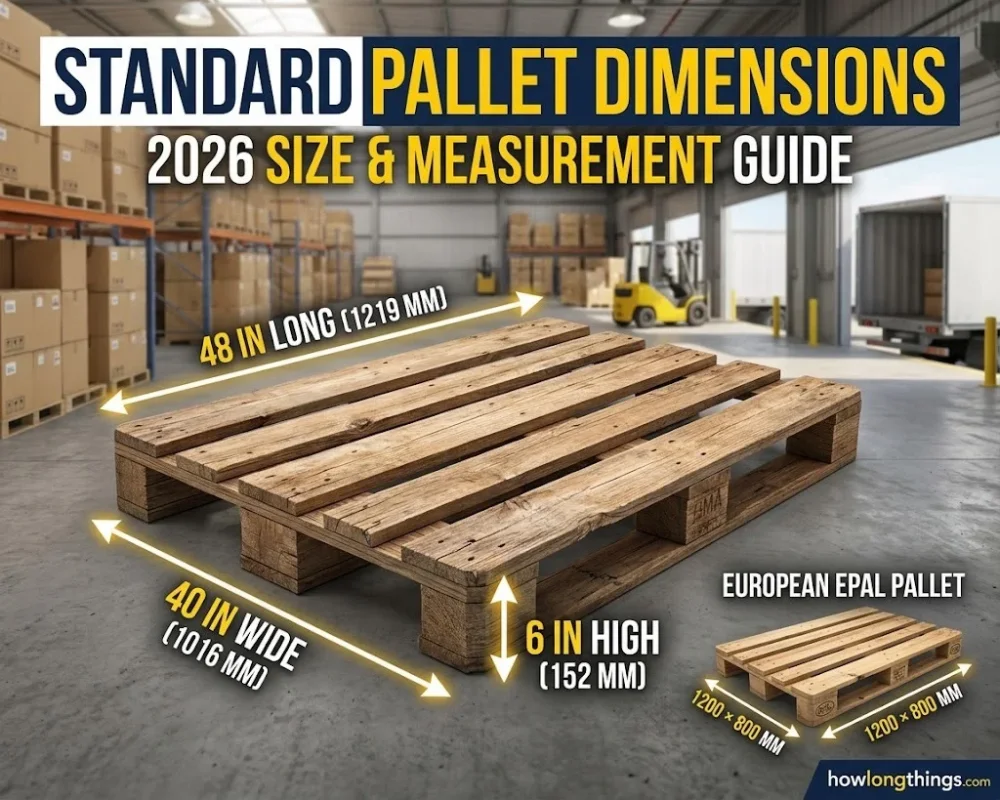
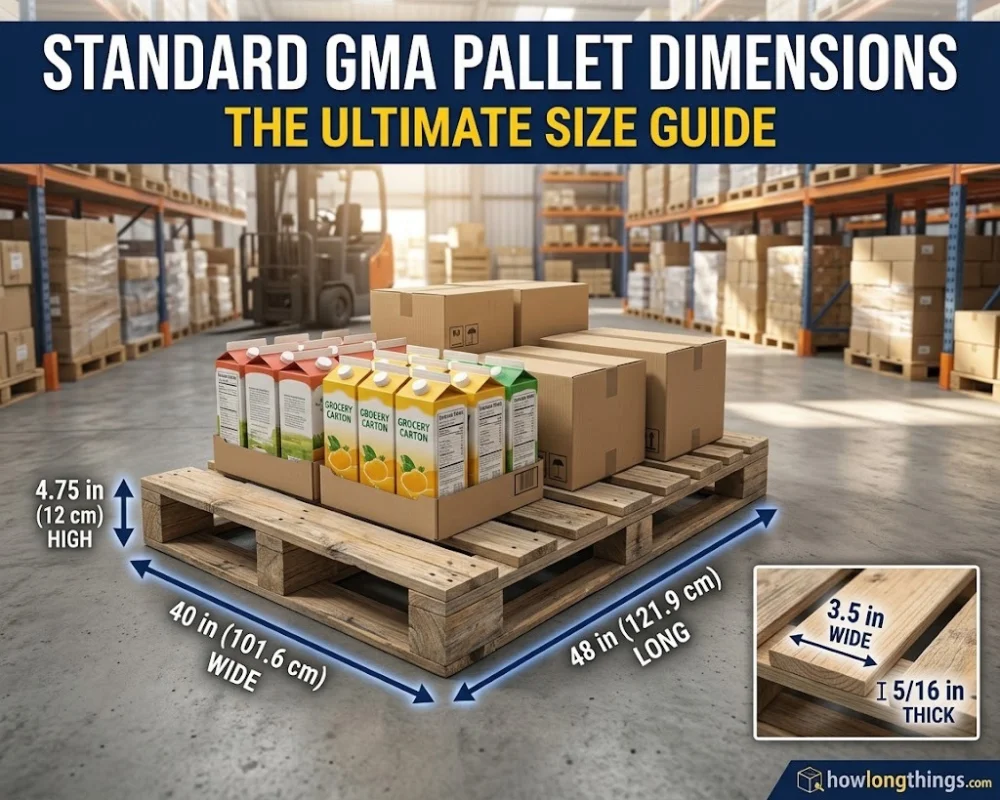
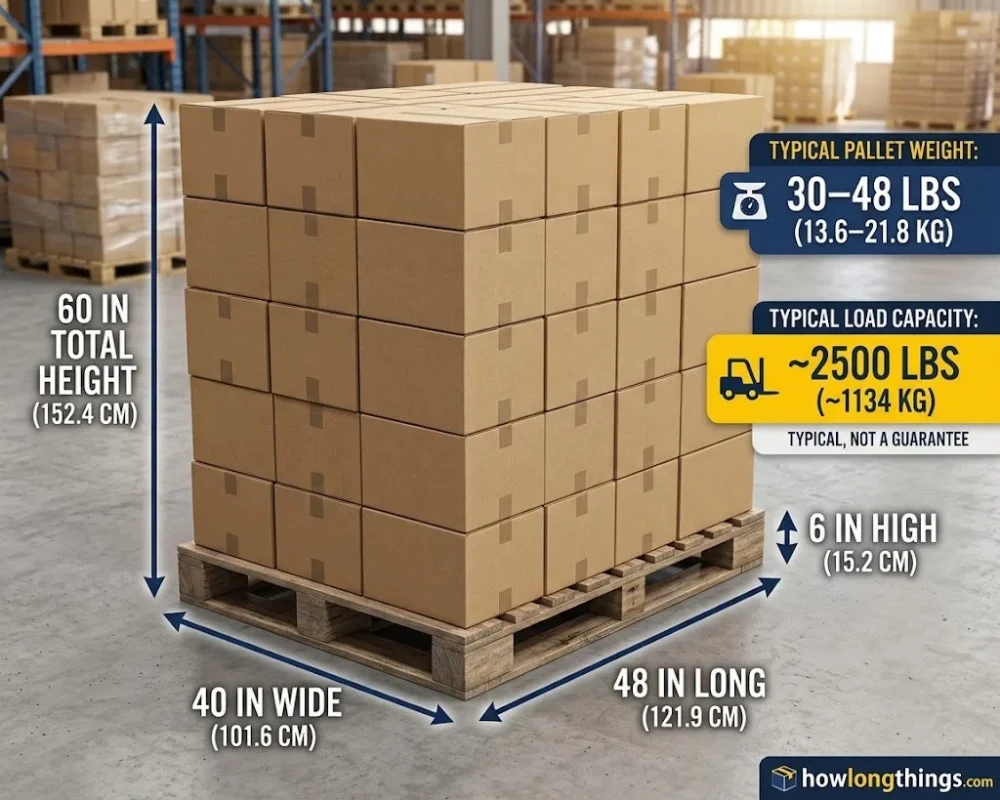
The standard pallet dimensions in the USA are 48 x 40 inches (1,219 x 1,016 mm). It is called the GMA pallet, and it is the most used standard pallet size in North America.
This guide gives you pallet dimensions in inches and cm. It also covers height, weight, load limits, pallet types, and truck fit, so you can pick the right pallet the first time.
Table of Contents
Standard Pallet Dimensions in the USA (48 x 40)
The 48 x 40 pallet is named for the Grocery Manufacturers Association. That group is now the Consumer Brands Association (CBA), so you will see both names.
What is the standard pallet size in the USA? It is 48 inches long and 40 inches wide. That is about 121.9 x 101.6 cm. A Virginia Tech and USDA Forest Service study found it was the most common size in North America, at about 26% of pallets. Other industry sources put the share closer to 30%. The grocery trade drives that demand.
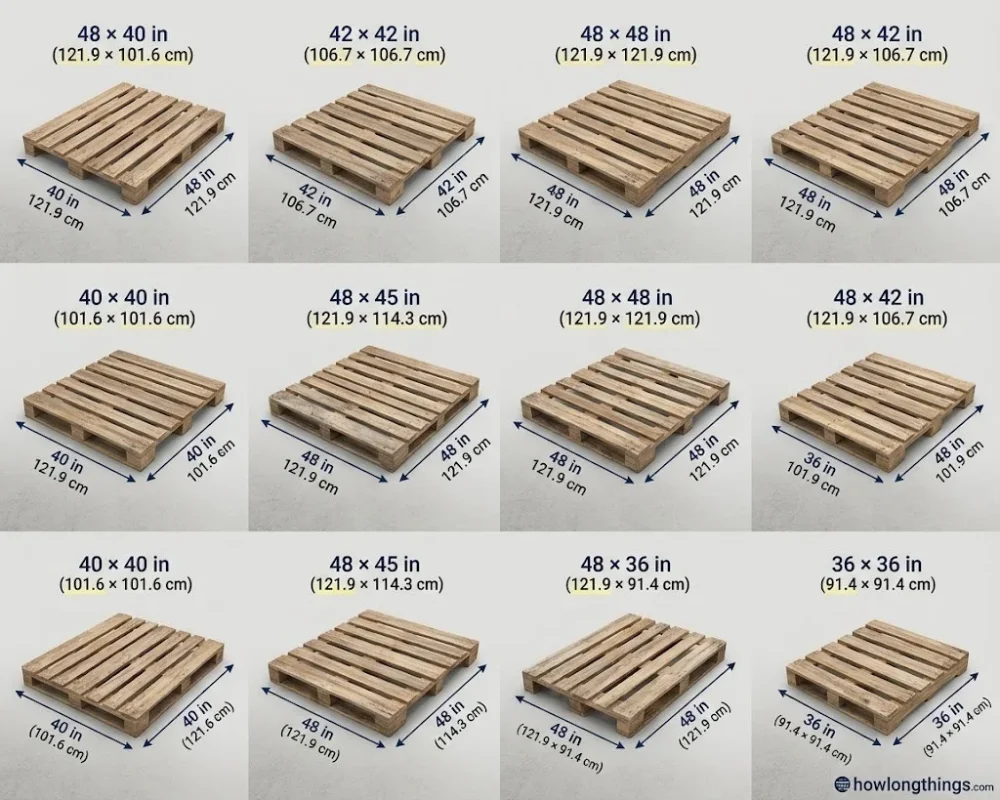
The deck boards on a standard 48 x 40 pallet are about 3.5 inches wide and 5/16 inch thick. Here are the other common pallet sizes used in the USA.
Size (in)
Size (cm)
Common use
48 x 40
121.9 x 101.6
Grocery and general freight
42 x 42
106.7 x 106.7
Telecom and paint
48 x 48
121.9 x 121.9
Drums (55-gallon)
48 x 42
121.9 x 106.7
Chemical and beverage
40 x 40
101.6 x 101.6
Dairy
48 x 45
121.9 x 114.3
Automotive
48 x 36
121.9 x 91.4
Beverage, shingles, paper
36 x 36
91.4 x 91.4
Beverage and small loads
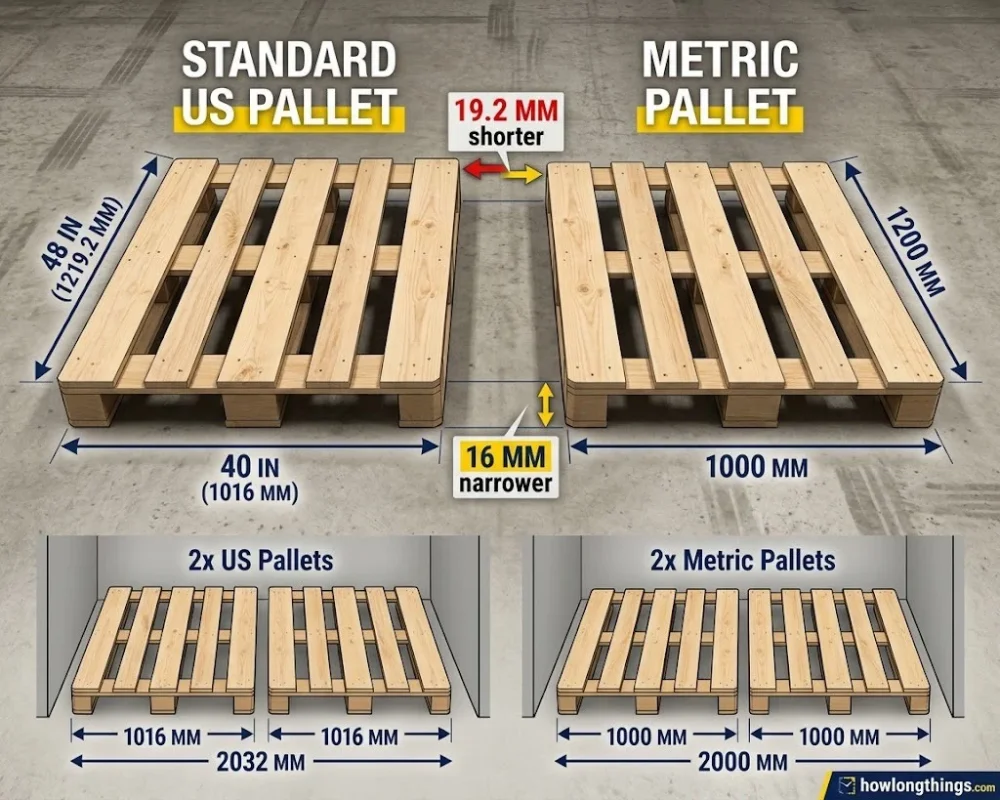
Is 48 x 40 the same as 1200 x 1000 mm? No. One inch is exactly 25.4 mm, per NIST. So 48 x 40 inches equals 1,219.2 x 1,016 mm. The metric pallet is 19.2 mm shorter and 16 mm narrower.
That small gap matters. Two 1,016 mm pallets need 2,032 mm of width. Two 1,000 mm pallets need 2,000 mm. In a tight space, one choice fits and the other loses a row. Also remember that listed sizes are nominal. Always check the supplier drawing before you buy.
Just as pallet dimensions matter for efficient shipping and storage, accurate measurements are equally important when planning space for large electronics. If you’re setting up a home theater or entertainment area, understanding thedimensions of a 100-inch TVcan help you determine the ideal viewing space and ensure a proper fit.
Standard Pallet Sizes by Country and ISO Standards
There is no single world pallet. Each region built its own around its trucks, racks, and trade routes.
Region
Size (mm)
Size (in)
USA and Canada
1,219 x 1,016
48 x 40
Europe (EPAL 1)
1,200 x 800
47.24 x 31.50
Europe (EPAL 2) and UK
1,200 x 1,000
47.24 x 39.37
Australia and New Zealand
1,165 x 1,165
45.87 x 45.87
China and Japan
1,100 x 1,100
43.31 x 43.31
South Korea
1,100 x 1,000
43.31 x 39.37
Brazil
1,200 x 1,000
47.24 x 39.37
The Euro pallet (EPAL 1) measures 1,200 x 800 x 144 mm and weighs about 25 kg. EPAL rates it for a safe working load of 1,500 kg under its own conditions.
ISO 6780 sets the main dimensions and tolerances for flat pallets. It approves six sizes: 1,219 x 1,016, 1,200 x 1,000, 1,165 x 1,165, 1,067 x 1,067, 1,100 x 1,100, and 1,200 x 800 mm.
Does ISO make every pallet interchangeable? No. You still need to check fork entry, build, condition, and load rating.
Container fit shows why the choice matters. In a 40-ft ISO container, the 48 x 40 pallet wastes only about 3.7% of the floor and fits 20 pallets. The 1,100 x 1,100 pallet wastes about 14%. The Euro pallet wastes about 15%.
Shipping wood pallets overseas? The ISPM 15 rule from the IPPC applies. Wood pallets must be debarked, treated, and stamped with the wheat mark. Plastic pallets usually skip this rule.
Pallet Height, Weight, and Load Capacity
Footprint is only half the story. Height, weight, and rating decide whether a pallet works for your load.
What is the standard pallet height? An empty pallet is about 5 to 6.5 inches tall. So the full answer for a standard pallet is 48 x 40 x 6 inches. Keep the loaded stack near 60 inches (1,524 mm) for load stability.
Material
Typical weight
Typical load capacity
Best for
Wood
30-48 lb (up to 70 lb)
About 2,500 lb (some list up to 4,600 lb)
General freight, low cost
Plastic
13-50 lb
3,500-17,600 lb (heavy-duty models list more)
Food, pharma, export
Metal
50-150 lb
Built for heavy gear
Machinery, harsh sites
Cardboard
Very light
Light loads only
One-way, light freight
What is the difference between static, dynamic, and racking load? Static load is weight on a pallet resting on the floor. Dynamic load is weight while a forklift or pallet jack moves it. Racking load is weight while the pallet sits on rack beams. Racking limits are often the lowest. Never swap one rating for another.
Weight also drives cost. Pallet weight is the top factor in freight pricing, followed by size, distance, and shipping method (LTL or FTL). As a rule, palletize any freight over 75 lb or wider or taller than 42 inches.
Pallet Types and How to Pick the Right Pallet Size
Three designs cover most of the market. Double face and double wing pallets are common variations. A skid is different: it has no bottom deck board.
Stringer Pallets
Stringer pallets use 2 x 4 boards between the top and bottom decks. They are the most common design and the cheapest to build and repair. Forklifts enter from two sides, or four if the stringers are notched. Pallet jacks fit only along the length.
Block Pallets
Block pallets use blocks instead of stringers. Forklifts and pallet jacks can enter from all four sides. They are stronger and steadier, but they cost more.
Solid Deck Pallets
Solid deck pallets have a closed top with no gaps. They suit small, loose, or uneven items that could fall through deck spaces.
How to Calculate Pallet Size
Measure your carton. Divide the pallet length and width by the carton length and width. Round each answer down. Multiply the two to get cartons per layer. Then divide the free height by the carton height to get layers.
Example: A carton is 16 x 12 x 10 inches. On a 48 x 40 pallet, 48 / 16 = 3 and 40 / 12 = 3. That gives 9 cartons per layer. The free height is 60 – 6 = 54 inches, so 54 / 10 = 5 layers. The pallet holds 45 cartons. Keep every box inside the edges. Overhang makes freight more likely to get damaged.
Standard Pallet Dimensions for Trucks and Containers
40-ft container: 20 pallets of 48 x 40.
53-ft trailer: about 26 pallets with the 40-inch side across (2 across, 13 rows).
53-ft trailer, turned: up to 30 pallets with the 48-inch side across (2 across, 15 rows).
These counts are estimates from a roughly 100 x 636 inch trailer floor. Check your trailer and weight limits.
How do you choose? Match the pallet to five things: your product size and weight, rack beam spacing, forklift entry type, export rules, and cost per trip. Custom sizes make sense for oversize products, IBC drums, or racks built for another base.
Standard Pallet Dimensions FAQs
What is a standard pallet size LxWxH?
It is 48 x 40 x about 6 inches (1,219 x 1,016 x about 152 mm). Height changes with pallet design.
What is standard pallet size in cm?
The US standard is 121.9 x 101.6 cm. The Euro pallet is 120 x 80 cm. The Australian pallet is 116.5 x 116.5 cm. The common Asian pallet is 110 x 110 cm.
Is a standard pallet 40×48?
Yes. 40 x 48 and 48 x 40 are the same pallet. US trade lists the length first (48 x 40). Some lists give the width first.
What is a good pallet size?
In the USA, 48 x 40 is the safest pick. It has the widest supply and fits most racks and carriers. For Europe, use 1,200 x 800 mm. For Australia, use 1,165 x 1,165 mm. Always pick a size that keeps the load inside the edges.
What are the three types of pallets?
Stringer, block, and solid deck. Pallets also come in wood, plastic, metal, and cardboard.
How to calculate the pallet size?
Divide the pallet length and width by your carton length and width, and round down. Multiply the results for cartons per layer. Then add layers up to about 60 inches of total height.
Conclusion
The standard pallet dimensions in the USA are 48 x 40 inches. Check height, load rating, and entry type before you buy, and match the pallet to your racks, trucks, and destination.
Elizabeth Queen is a Owner and consumer research writer at HowLongThings.com, specializing in product lifespan, durability, and everyday household research. She’s passionate about helping readers make smarter, longer-lasting buying decisions.