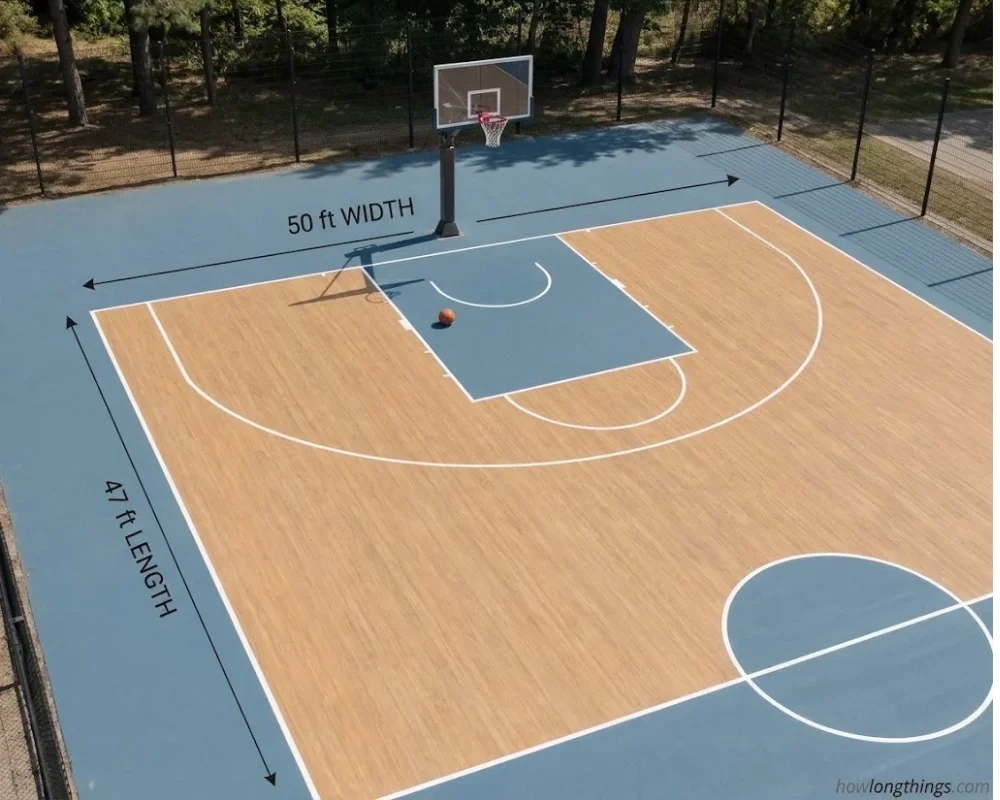
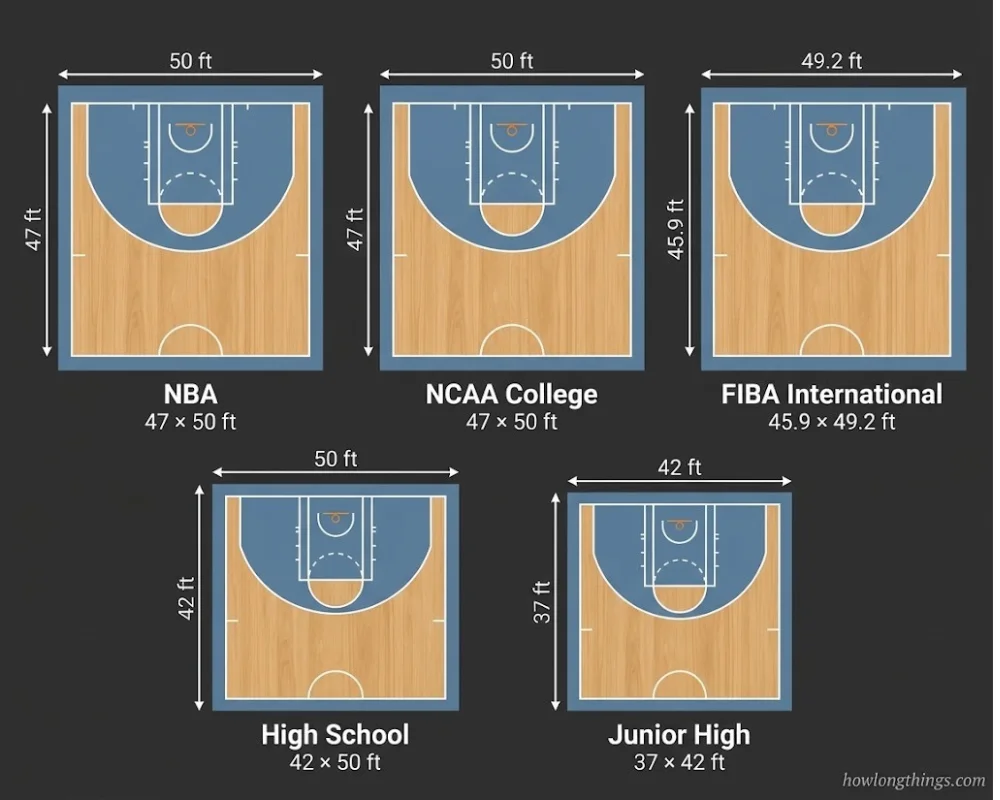
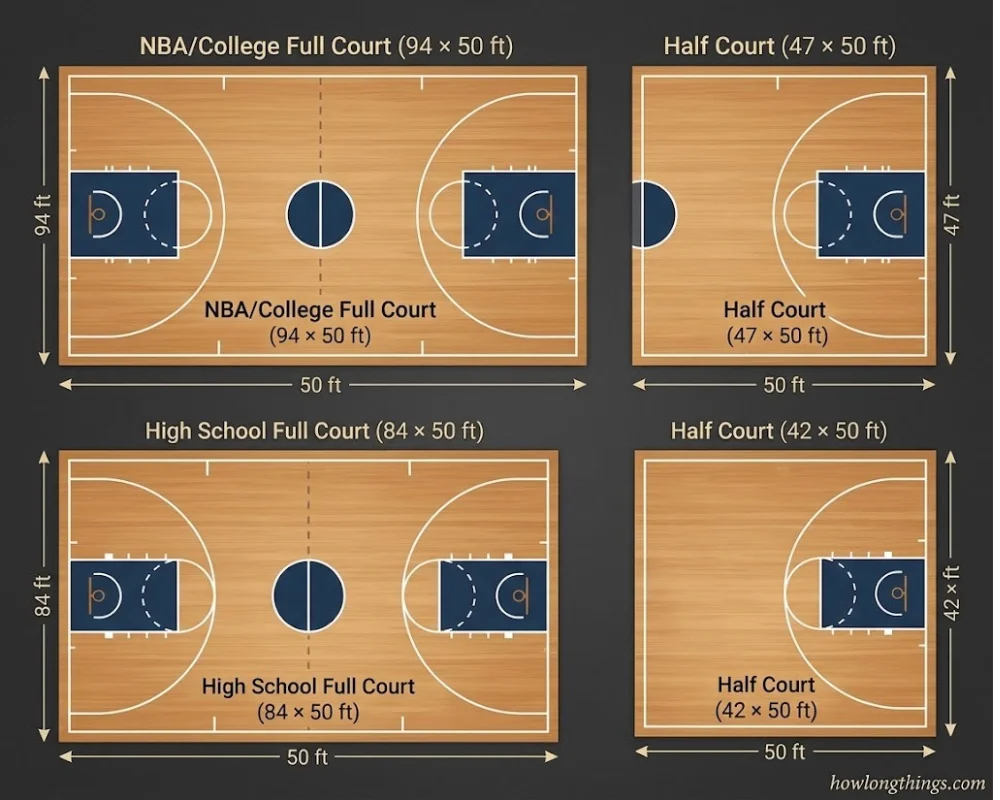
The official half court basketball dimensions are 47 feet long by 50 feet wide for the NBA and college. High school courts are 42 feet by 50 feet.
That is the short answer. Below, you’ll find every key line, the three-point distances, and the space you need to build one at home.
Table of Contents
Half Court Basketball Dimensions by Level of Play
A half court is a full court cut at the midcourt line. It has one hoop, one three-point arc, one free throw line, and half of the center circle.
Width stays at 50 feet for most levels. Length is what changes. The NBA court rules set a full court at 94 feet. High school courts, under NFHS rules, run 84 feet. That is why a high school half court is five feet shorter.
Level
Full Court
Half Court
Area
NBA
94 x 50 ft
47 x 50 ft
2,350 sq ft
College (NCAA)
94 x 50 ft
47 x 50 ft
2,350 sq ft
High school (NFHS)
84 x 50 ft
42 x 50 ft
2,100 sq ft
Junior high
74 x 42 ft
37 x 42 ft
1,554 sq ft
FIBA (international)
91.9 x 49.2 ft
about 45.9 x 49.2 ft
about 2,260 sq ft
Most real-world half courts are not exact halves. Gyms, parks, and driveways often trim the length. The lines stay the same size, though.
Planning a basketball half court requires careful measurements, and the same attention to dimensions helps when arranging furniture in your home. If you’re updating your bedroom or optimizing storage space, explore this guide to standard dresser dimensions to compare typical widths, heights, and depths before choosing the right fit.
Half Court Markings: Key, Free Throw Line and Three-Point Line
Here are the half court basketball measurements that matter most.
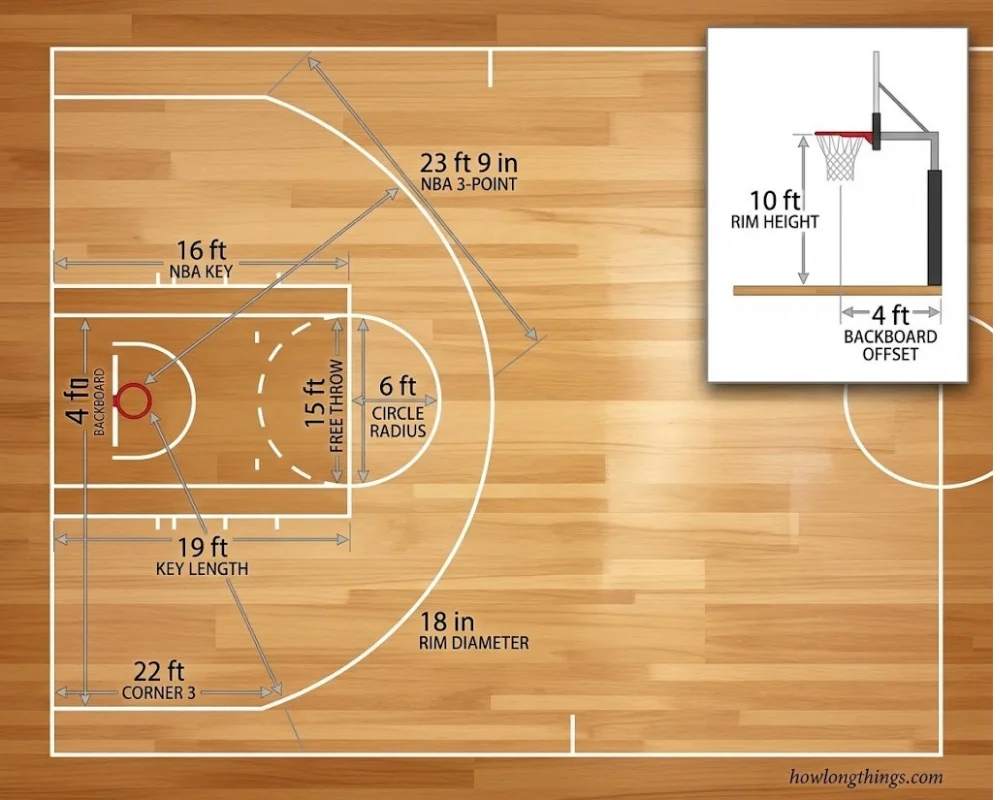
What is the key in basketball? The key, also called the lane or the paint, is the painted box under the hoop. It runs 19 feet from the baseline to the free throw line. The NBA key is 16 feet wide. College and high school keys are 12 feet wide.
How far is the free throw line? It sits 15 feet from the face of the backboard at every level. The free throw circle has a 6-foot radius.
How far is the three-point line?
NBA: 23 ft 9 in at the top, 22 ft in the corners.
College (men and women): 22 ft 1.75 in. The NCAA uses the same line for women and men. The women’s line used to be shorter, at 20 ft 9 in, before the 2021–22 season.
High school: 19 ft 9 in.
The NBA corner three is shorter because the sideline is only 3 feet from the line there. A full arc would run out of floor.
Hoop and backboard specs never change with court size:
Rim height: 10 feet
Rim diameter: 18 inches
Backboard: 72 x 42 inches
Backboard distance from the baseline: 4 feet
NBA and college courts also paint a 4-foot restricted area arc under the rim. It helps referees call charges.
How Much Space Do You Need for a Backyard Half Court?
More Americans are playing at home. Statista data shows nearly 30 million people played basketball in 2023. Most of them don’t have 2,350 square feet to spare.
Common backyard half court sizes:
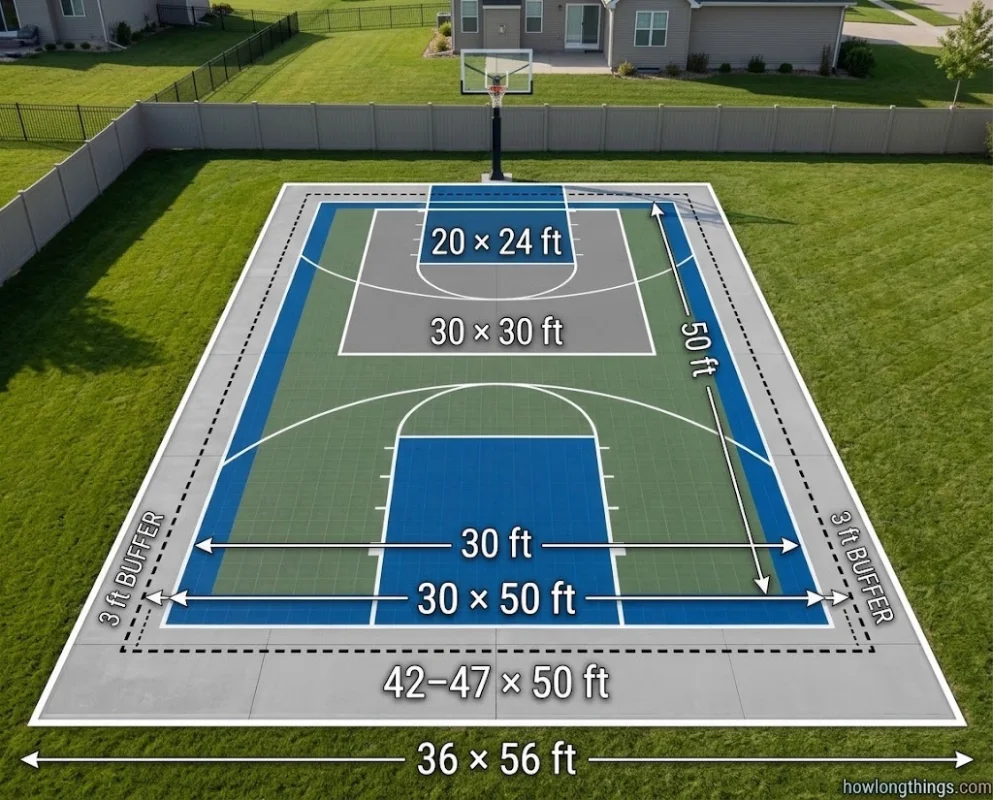
20 x 24 ft: a shooting pad for free throws and layups.
30 x 30 ft: a compact court for key play and pickup games.
30 x 50 ft: the best balance. It keeps full regulation width and fits a high school arc.
42–47 x 50 ft: near-regulation, with room for college and NBA lines.
Will a three-point arc fit? Check the math first. The arc needs about 25 ft of depth and 39.5 ft of width at the high school line. At the college line, it needs about 27.5 ft by 44 ft. A 30-foot-wide court can’t hold a full arc at any level.
Don’t forget run-off space. This is the open floor beyond the lines. Plan for at least 3 feet for casual play and 10 feet or more for competitive use. A 30 x 50 ft court with a 3-foot buffer grows to 36 x 56 ft, or 2,016 square feet.
Two more tips before you pour concrete:
Backboard overhang: this is how far the backboard sits past the pole. Official courts use 4 feet. Home courts often use 2 to 4 feet. More overhang gives players room to run behind the hoop. Add pole padding either way.
Local rules: check setbacks, zoning, and HOA limits. They can shrink your buildable area fast.
Mark the lines with chalk or tape first. It takes ten minutes and shows you what fits.
Half Court vs Full Court: Quick Size Comparison
A full court is exactly double the length of a half court. An NBA or college full court is 94 x 50 ft. Its half court is 47 x 50 ft. A high school full court is 84 x 50 ft, so its half court is 42 x 50 ft.
Half courts work well for drills, 2-on-2, and 3-on-3. They also suit driveways, school gyms, and rec centers. Full courts matter only when you need fast breaks and two hoops.
Half Court Basketball Dimensions FAQs
What is the size of a half basketball court?
An NBA or college half court is 47 x 50 feet. A high school half court is 42 x 50 feet. Home courts are often smaller, such as 30 x 50 feet.
Is 30×30 big enough for a basketball court?
Yes, for casual play. It fits the key, the free throw line, and pickup games. It can’t hold a full three-point arc, which needs at least 39.5 feet of width.
What is a half court in basketball?
It is one end of a full court, with one hoop and one set of lines. Teams use it for half court offense, drills, and 3-on-3 games.
What are the size dimensions of a basketball court?
NBA and college courts are 94 x 50 feet. High school courts are 84 x 50 feet. Junior high courts are 74 x 42 feet. FIBA courts are about 91.9 x 49.2 feet.
How much space do you need for a half-court?
A regulation half court needs 47 x 50 feet, plus run-off space. At home, plan for at least 30 x 50 feet to fit a high school three-point arc. Add 3 feet or more around the edges.
What is a good size for a basketball court?
For most yards, 30 x 50 feet is a good size. It keeps regulation width and gives you room to shoot, drive, and play small games.
Final word:
Remember two numbers: 47 x 50 ft for NBA and college, and 42 x 50 ft for high school. Measure your space, plan the arc, and leave room beyond the lines.
Elizabeth Queen is a Owner and consumer research writer at HowLongThings.com, specializing in product lifespan, durability, and everyday household research. She’s passionate about helping readers make smarter, longer-lasting buying decisions.