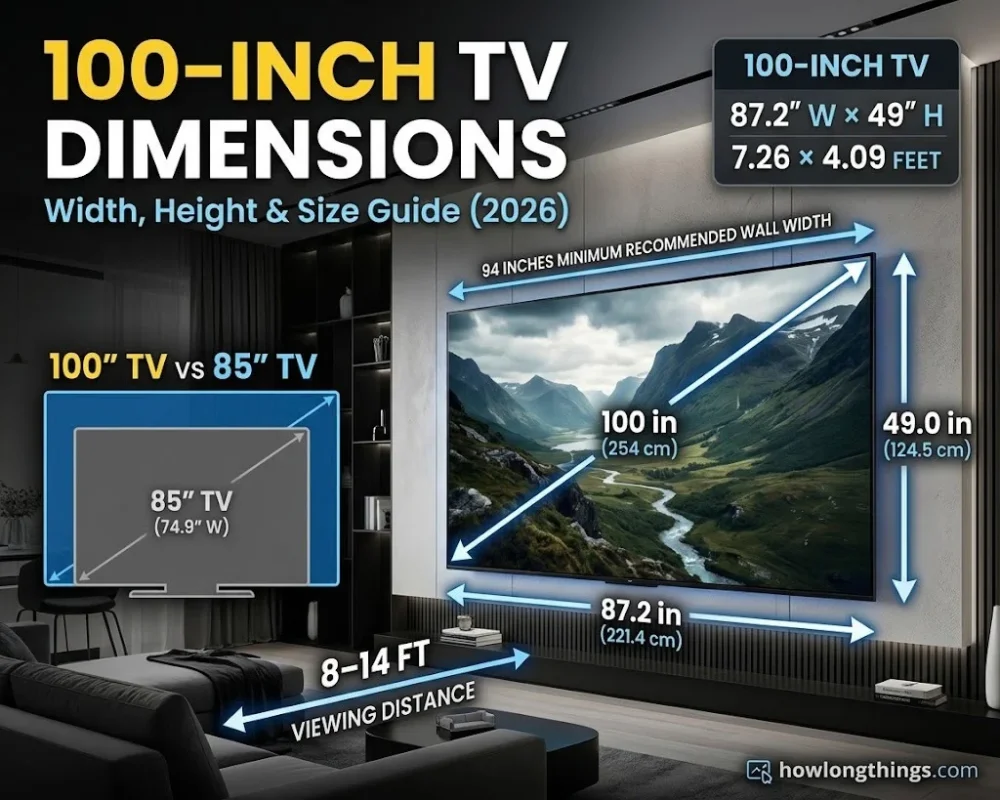
A 100-inch 16:9 TV is about 87.2 inches wide and 49 inches tall. That is 221.4 × 124.5 cm, or roughly 7.3 × 4.1 feet.
This guide covers the full 100-inch TV dimensions, how it stacks up against other sizes, the space it needs, and the right way to measure.
Table of Contents
100-Inch TV Dimensions: Width, Height & Diagonal
The “100 inches” in the name is the diagonal, measured from one corner of the screen to the opposite corner. It is not the width.
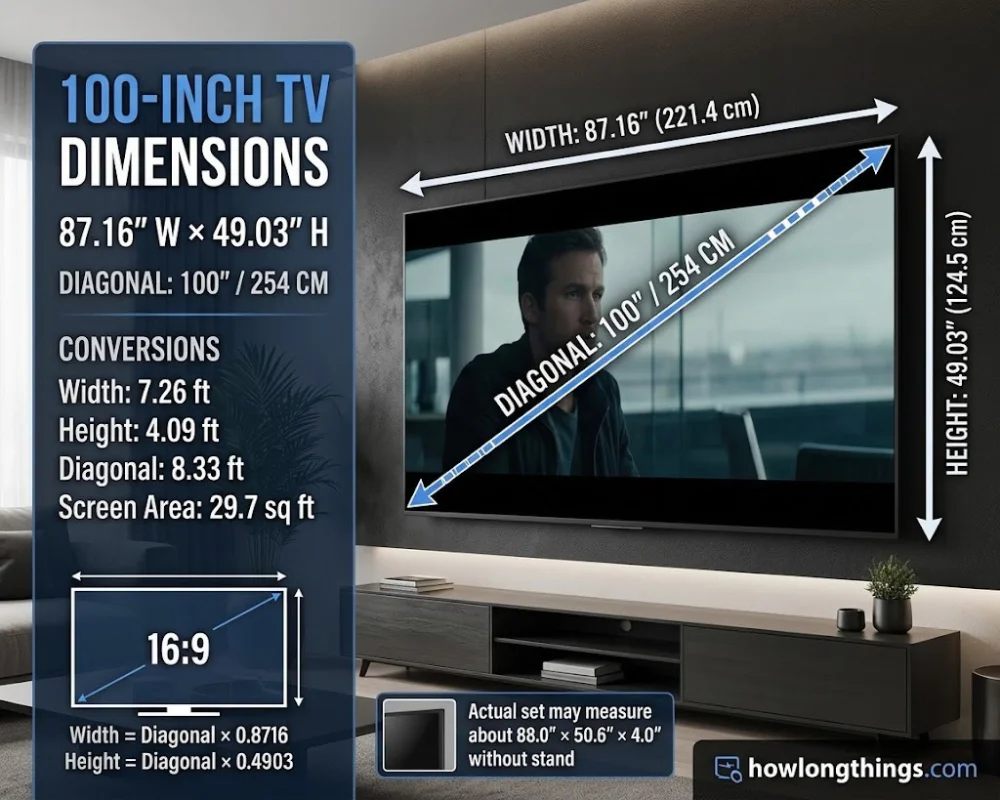
Here are the 100 inch TV dimensions for a standard 16:9 screen, shown in three units.
Measure
Inches
Centimeters
Feet
Diagonal
100.00 in
254.0 cm
8.33 ft
Width
87.16 in
221.4 cm
7.26 ft
Height
49.03 in
124.5 cm
4.09 ft
Screen area
4,273 sq in
27,568 sq cm
29.7 sq ft
You can work out any size yourself. Multiply the diagonal by 0.8716 for the width. Multiply it by 0.4903 for the height. These numbers come from the 16:9 aspect ratio.
What is the size of a 100-inch TV in real life? A little bigger than the table. The plastic bezel adds about an inch, and the “100-inch” label is often a size class. Hisense lists its 100U76N with a 99.5-inch actual diagonal. The full set measures 88.0 × 50.6 × 4.0 inches without the stand.
With the stand, the same TV is 52.0 inches tall and 19.7 inches deep. It weighs 132.3 lb without the stand and 137.8 lb with it. Weight changes a lot between models, so check your exact spec sheet.
Numbers on paper are hard to picture. These everyday objects help.
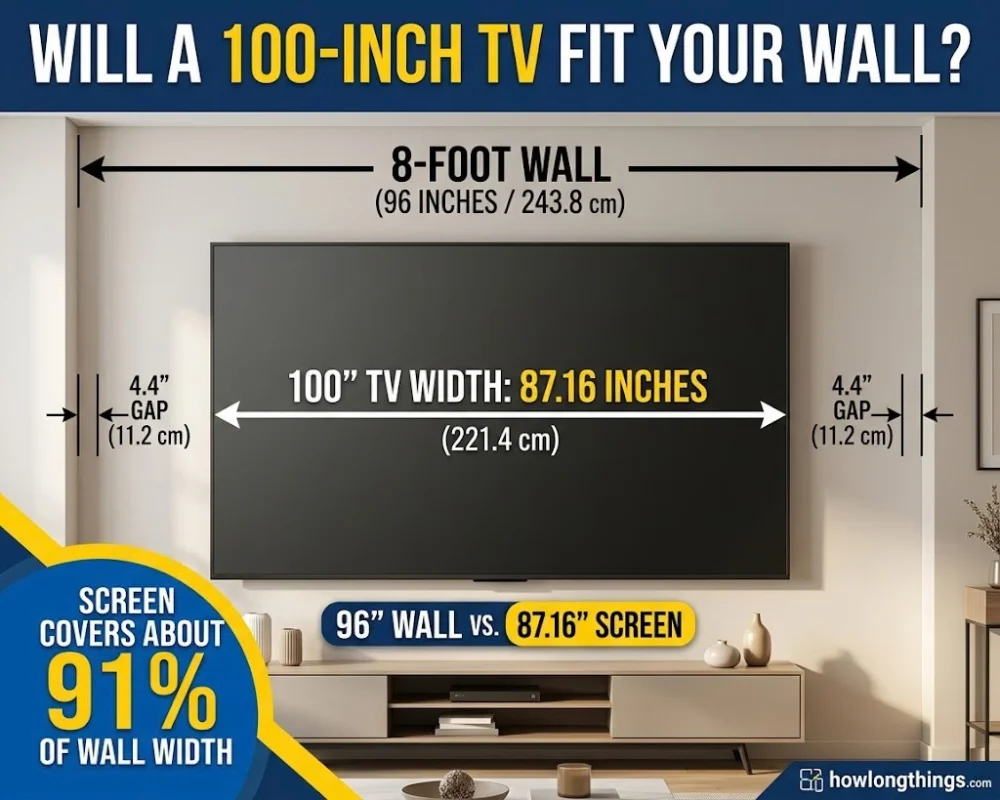
Eight-Foot Wall
A wall that is 8 feet wide measures 96 inches. The screen alone covers about 91% of that width.
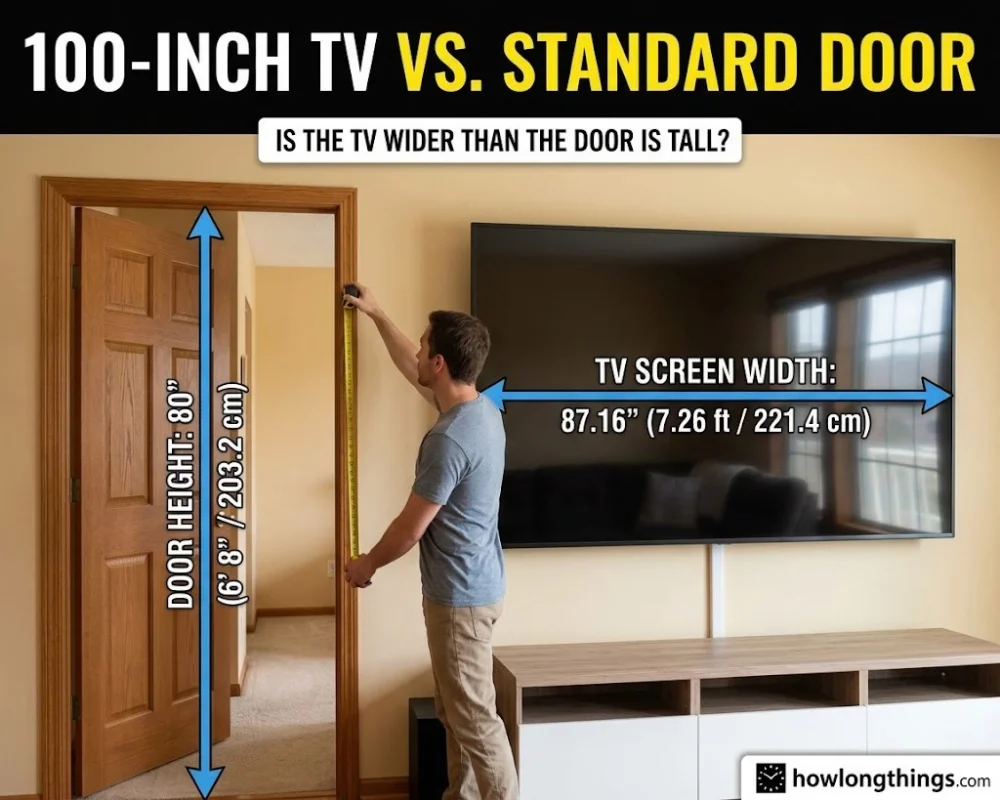
Interior Door
A standard interior door is 80 inches tall. A 100-inch TV is wider than that door is high.
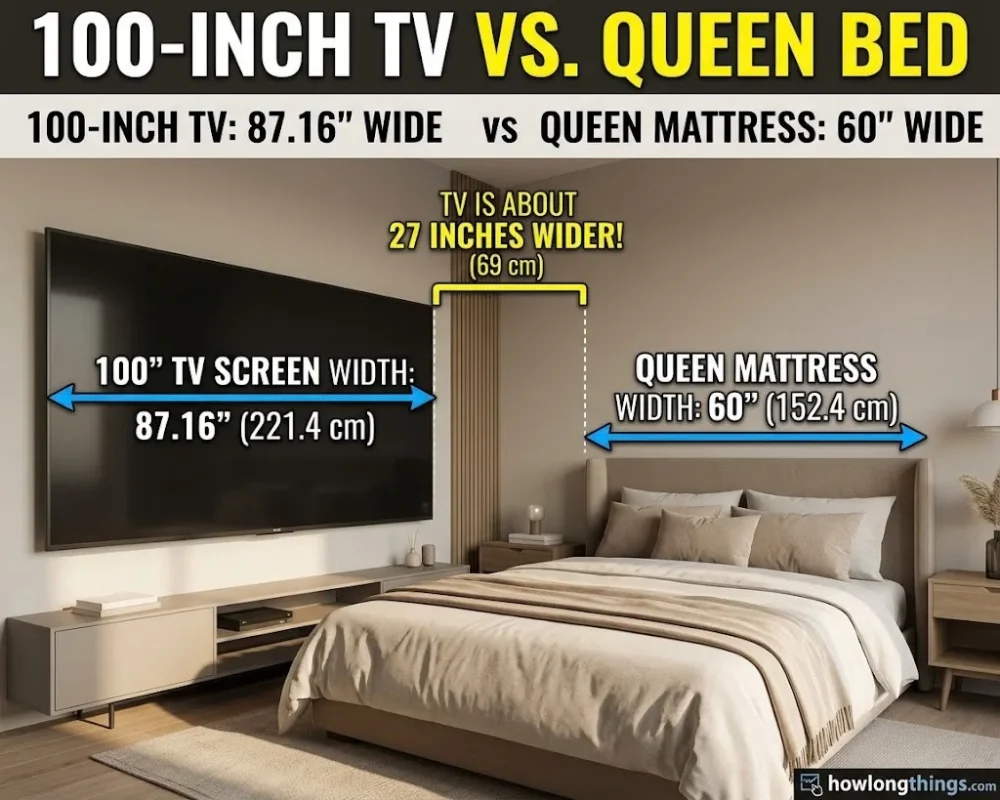
Queen Bed
A queen mattress is 60 inches wide. The screen is about 27 inches wider.
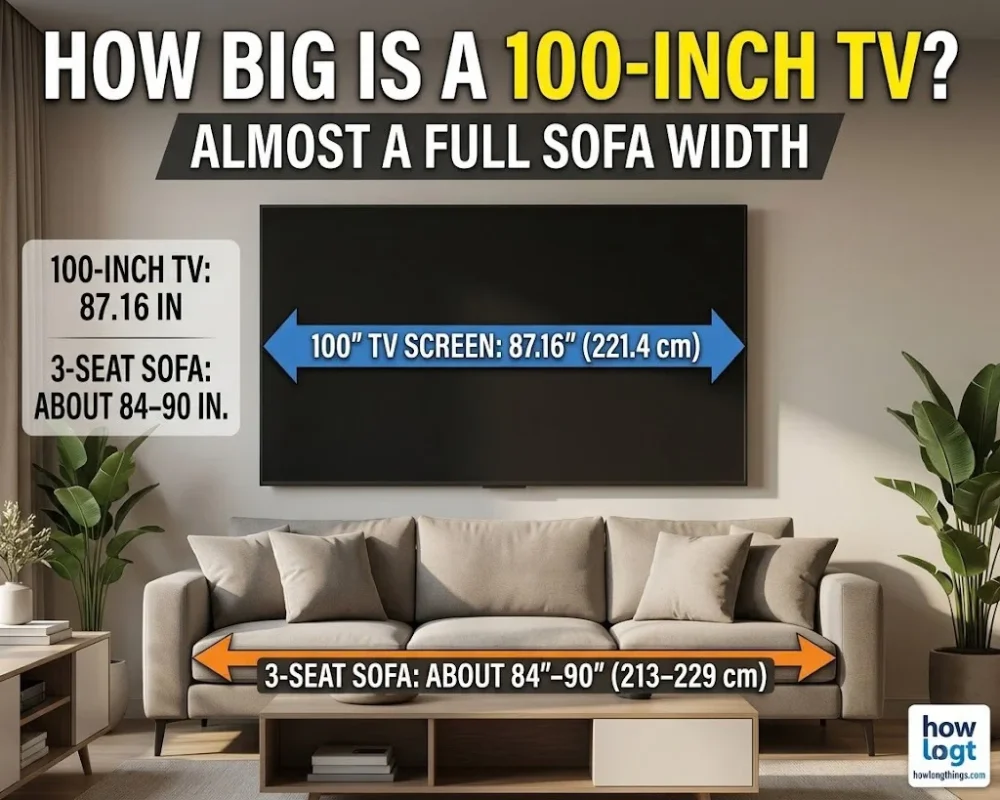
Three-Seat Sofa
Many three-seat sofas measure roughly 84 to 90 inches across. The TV is close to a full sofa width, so it can look huge on a small wall.
Writing
Choosing the right TV size requires careful planning of measurements and available space, and the same principle applies to industrial storage containers. Understanding standard IBC tote sizes and capacities helps you compare dimensions, plan warehouse layouts, and make better use of your available space.
100-Inch TV Size vs Other TV Sizes
Sizes near 100 inches differ more than the numbers suggest. Screen area grows with the square of the diagonal.
TV size
Width
Height
Screen area
75-inch
65.4 in
36.8 in
16.7 sq ft
85-inch
74.1 in
41.7 in
21.4 sq ft
98-inch
85.4 in
48.0 in
28.5 sq ft
100-inch
87.2 in
49.0 in
29.7 sq ft
110-inch
95.9 in
53.9 in
35.9 sq ft
120-inch
104.6 in
58.8 in
42.7 sq ft
A 98-inch TV is only 4% smaller by area, so it is a handy fallback. Samsung and TCL both sell 98-inch models, and Hisense sells 100-inch sets. LG and Sony also make very large screens.
Moving up from an 85-inch to a 100-inch TV gives you about 38% more screen. Stepping from 100 to 120 inches adds 44%, and the 120-inch set is 104.6 inches wide.
Big screens are going mainstream. Omdia expects shipments of 80-inch and larger TVs to rise 44% from 2025 to 2029. That means 9 million units growing to over 13 million. North America is forecast to hold 28% of that ultra-large volume in 2029.
One warning on ultra-wide screens. A “100-inch” 21:9 display is about 91.9 inches wide and only 39.4 inches tall, so it needs a very different wall.
How Much Space Does a 100-Inch TV Need?
Plan for the whole room, not just the TV. Here is what matters most.
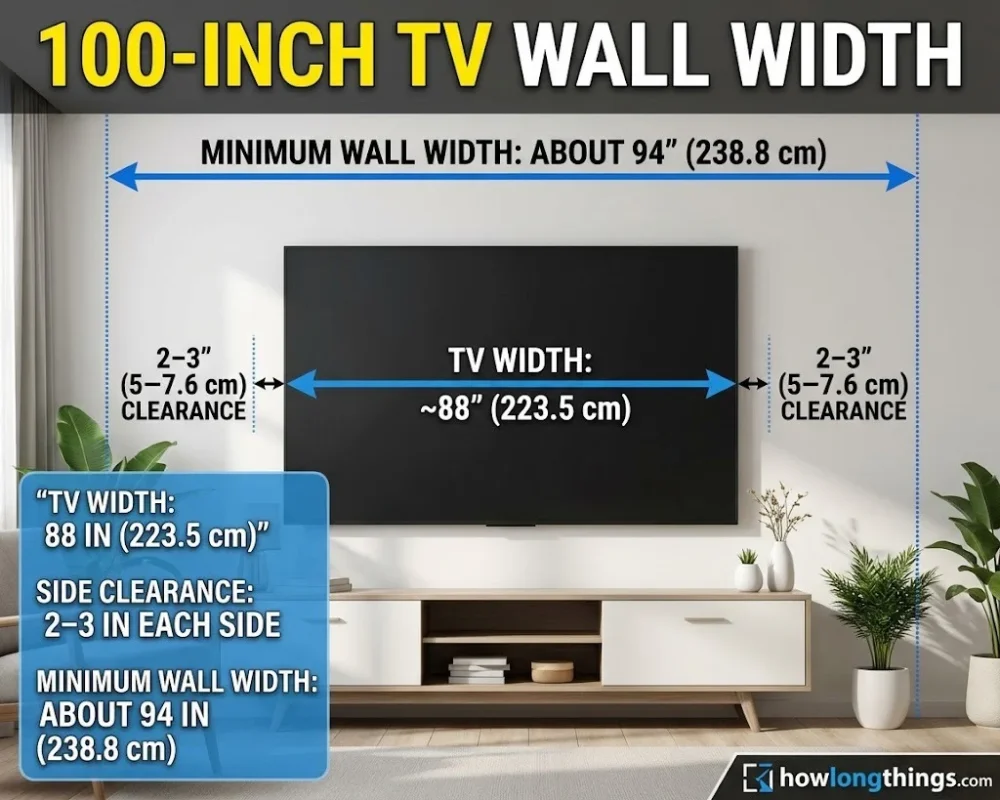
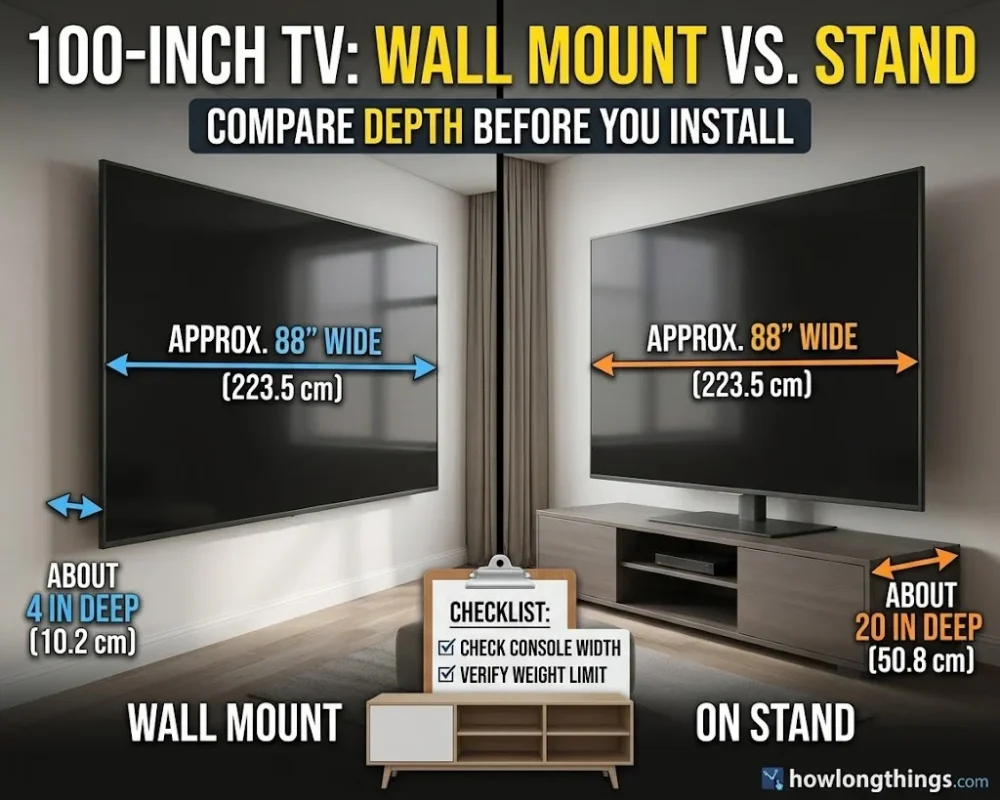
Wall width. The set is about 88 inches wide. Allow 2 to 3 inches on each side for cables and airflow. That puts the minimum wall width near 94 inches.
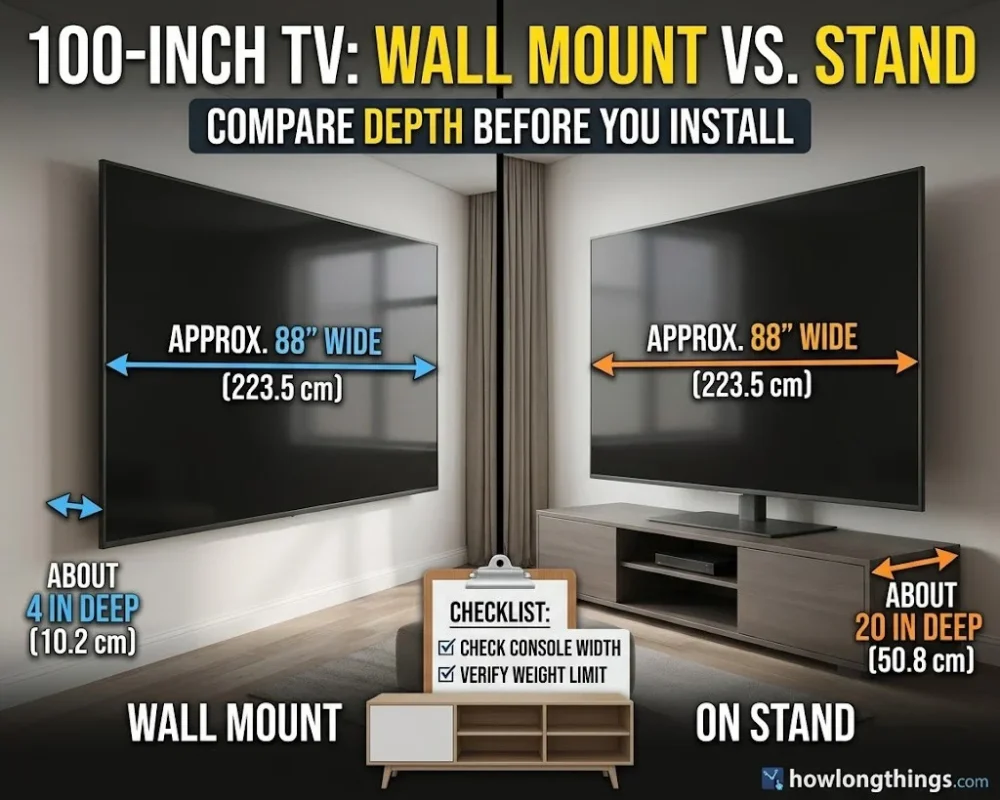
Wall mount or stand. A mount keeps the depth near 4 inches. A floor stand adds about 20 inches of depth, as on the Hisense 100U76N. Most media consoles are rated for far smaller TVs, so check width and weight limits first.
Mount and studs. Look for a VESA-compatible mount with a UL 2442 rating and a weight limit well above your TV. The Hisense sheet lists a 600 × 400 pattern, while a retailer lists 800 × 400. Confirm your pattern before you buy. In most US homes, studs sit 16 inches apart, so find at least two.
Delivery. The box is longer than the 88-inch TV. It fits through a standard door, but tight turns, stairs and elevators are the real trouble. Plan for at least two adults because of the weight.
Cables and light. Use HDMI 2.1 cables for 4K at high refresh rates, and eARC for soundbars. Place outlets behind the screen. Bright rooms favor Mini-LED or QLED panels with anti-glare coatings.
How far should you sit from a 100-inch TV? The answer depends on your seating style. The distances below come from the screen width and the SMPTE and THX viewing angles.
Seating style
Rule
Distance from a 100-inch TV
Close and immersive
About 1× the diagonal
About 8.3 ft (100 in)
Cinema-style (THX)
About 40° view angle
About 10 ft (120 in)
Mixed use (SMPTE)
About 30° view angle
About 13.6 ft (163 in)
Resolution matters too. With 20/20 vision, you can pick out single pixels closer than about 13 feet on 1080p and 6.5 feet on 4K. On 8K, the limit drops to about 3.3 feet. In most rooms, a 4K TV looks sharp from any normal sofa spot.
How to Measure a 100-Inch TV Correctly
Follow these steps with a tape measure before you order.
Measure the screen corner to corner. This is the diagonal, so the number should be close to 100 inches.
Measure the full width and height of the set, including the bezel.
Add the depth of the stand or the wall mount.
Measure the wall width, the stud spots, and the nearest outlet.
Measure every door, hallway turn and stair on the delivery path.
Use two quick conversions. Inches × 2.54 gives centimeters, and inches ÷ 12 gives feet.
Avoid three common mistakes. Do not measure straight across the front and call it the size. Do not forget the stand depth. And do not skip the doorway check.
FAQs About 100-Inch TV Dimensions
What is the size of a 100-inch TV?
A 100-inch TV measures 100 inches across the diagonal, which is 254 cm. On a 16:9 screen, that is about 87.2 inches wide and 49 inches tall (221.4 × 124.5 cm). The full set is slightly larger because of the bezel, and a stand adds height and depth.
How wide is a 100-inch screen?
A 100-inch 16:9 screen is about 87.2 inches wide, which is 221.4 cm or 7.26 feet. Real TVs with a bezel run closer to 88 inches. An ultra-wide 21:9 screen of the same diagonal is wider, at about 91.9 inches.
How much space is needed for a 100 inch TV?
Plan for a wall at least 94 inches wide, which is the 88-inch TV plus 2 to 3 inches per side. A floor stand needs about 20 inches of depth. Sit roughly 8 to 14 feet from the screen, depending on how immersive you want it.
What size TV is 100 cm wide?
A 16:9 TV with a screen 100 cm wide is about a 45-inch TV. The nearest common sizes are 43 inches (95.2 cm wide) and 50 inches (110.7 cm wide). If you mean 100 cm on the diagonal, that is about 39.4 inches, so look at 40-inch models.
How large is a 100 inch TV?
A 100-inch TV has about 29.7 square feet (4,273 square inches) of screen. That is roughly 38% more than an 85-inch TV and 31% less than a 120-inch TV. Weight varies by model, and one Hisense spec sheet lists 132.3 lb without the stand.
How to measure TV size 100 inch?
Measure the screen from one corner to the opposite corner. That diagonal should be near 100 inches. Then measure the width and height with the bezel, and check them with the formula: width = diagonal × 0.8716 and height = diagonal × 0.4903. Finally, add stand depth and measure your wall.
Final Thoughts
A 100-inch TV is about 87 by 49 inches, but the real fit depends on three things: your wall, your doorway, and where you sit. Check those first, and the rest of the choice gets easy.
Elizabeth Queen is a Owner and consumer research writer at HowLongThings.com, specializing in product lifespan, durability, and everyday household research. She’s passionate about helping readers make smarter, longer-lasting buying decisions.