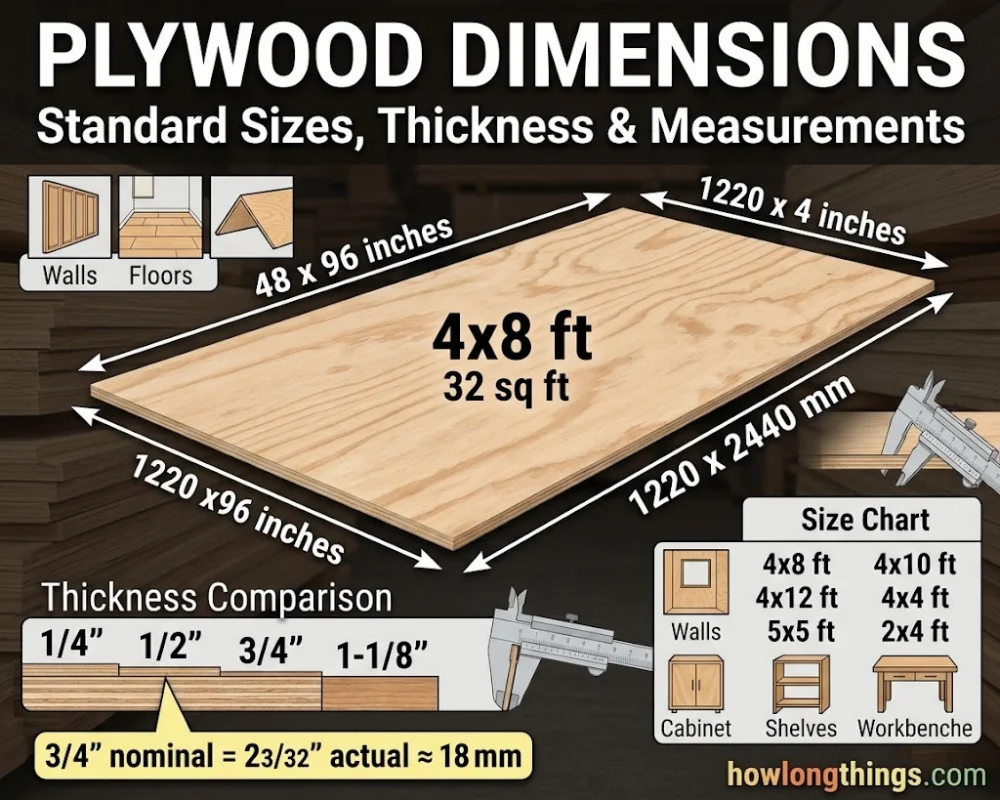
The standard plywood dimensions in the US are 4 ft × 8 ft. That is 48 × 96 inches, or about 1220 × 2440 mm. One sheet covers 32 square feet.
Thickness is where people get tripped up. A “3/4 inch” sheet is thinner than 3/4 inch. This guide covers plywood sizes, a plywood thickness chart, and tips for picking the right panel.
Table of Contents
Standard Plywood Sizes and Sheet Dimensions
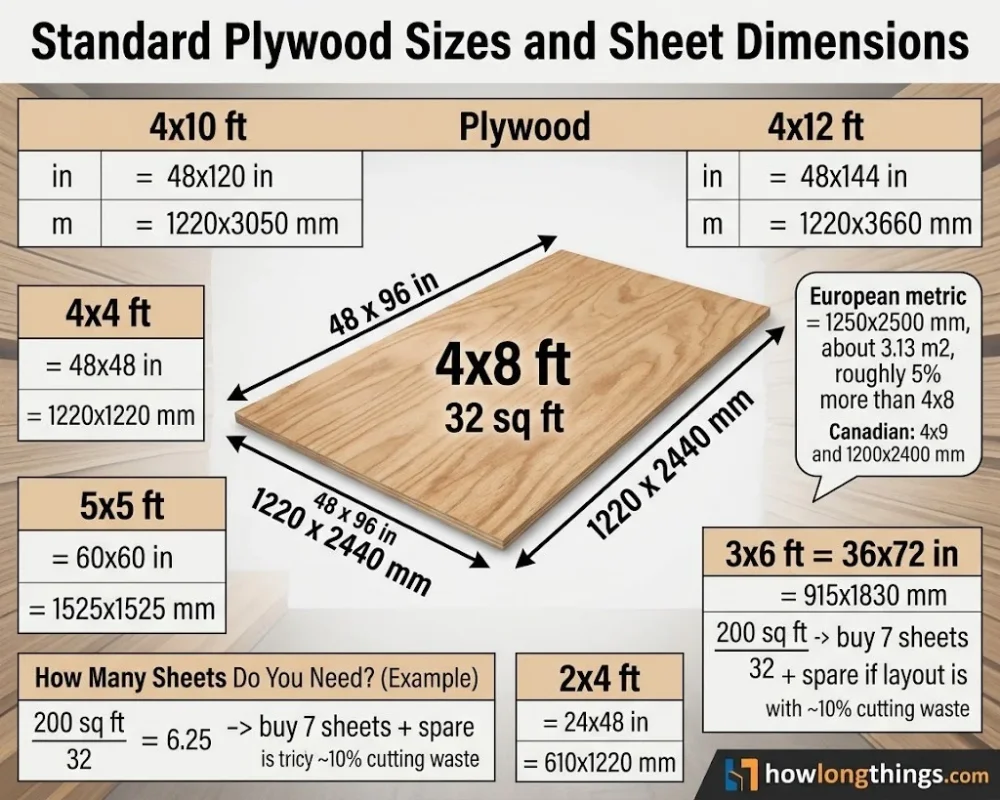
What is the standard plywood sheet size? It is 4×8 ft. The length and width are usually true to size. Metric mills cut it to 1220 × 2440 mm, which is a hair under a true 4×8 ft (1219.2 × 2438.4 mm).
Sheet size
Inches
Metric (mm)
Common use
4 × 8 ft
48 × 96
1220 × 2440
Walls, floors, roofs, cabinets
4 × 10 ft
48 × 120
1220 × 3050
Tall walls, fewer seams
4 × 12 ft
48 × 144
1220 × 3660
Commercial work
4 × 4 ft
48 × 48
1220 × 1220
Easy-carry half sheet
5 × 5 ft
60 × 60
1525 × 1525
Baltic birch for cabinet shops
2 × 4 ft
24 × 48
610 × 1220
Small cuts and repairs
Some metric sizes also exist. European mills use 1250 × 2500 mm, which covers about 3.13 m² (roughly 5% more than a 4×8). Canadian mills also make 4×9 and 1200 × 2400 mm panels (see industry size tables).
Longer sheets like 4×10 and 4×12 are often special order. Call the lumberyard before you plan around them.
How many sheets do you need? Divide your project area in square feet by 32. Then add about 10% for cutting waste. A 200 sq ft floor needs 200 ÷ 32 = 6.25, so buy 7 sheets, plus a spare if the layout is tricky.
Plywood Thickness Chart: Nominal vs Actual Size
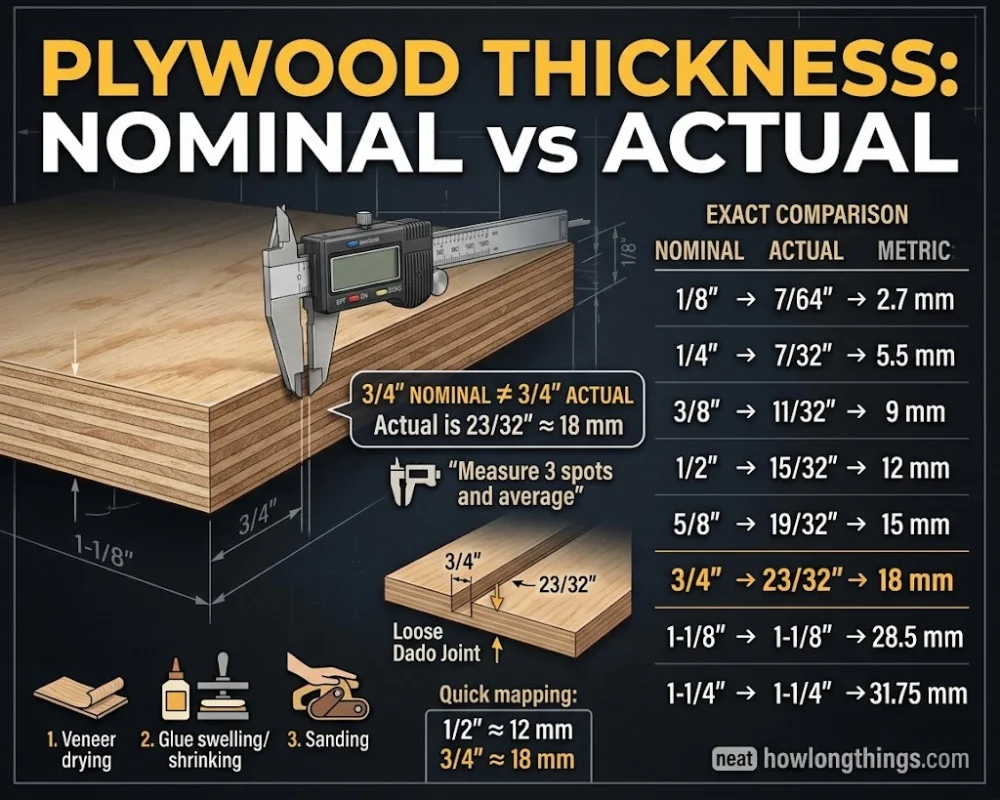
Nominal thickness is the label. Actual thickness is what a caliper reads. The gap is normal. It comes from veneer drying, glue swelling and shrinking, and sanding at the mill. Factories also tolerate panels that run thin more easily than panels that run thick.
Nominal (label)
Actual (inches)
Actual (mm)
1/8″
7/64″
2.7
1/4″
7/32″
5.5
3/8″
11/32″
9
1/2″
15/32″
12
5/8″
19/32″
15
3/4″
23/32″
18
1-1/8″
1-1/8″
28.5
1-1/4″
1-1/4″
31.75
Source for the actual sizes: this thickness chart. Panels over 1 inch are usually true to size.
The gap matters in fine work. A dado cut for a true 3/4 inch shelf will leave a loose fit with a 23/32 inch panel. Drawer joints and router bits have the same problem. Test-fit on a scrap piece first.
How do you measure plywood thickness? Use a caliper on a clean edge. Check three spots and write down the average. Check two or three sheets from the same stack, because tolerances vary by batch.
Inch to metric quick map: 1/2 in is about 12 mm. 3/4 in is about 18 mm. This is why a “12 mm” panel and a “1/2 in” panel are nearly the same.
Accurate dimensions matter in both physical projects and digital design, where the right image size can make a layout look polished and professional. For online branding, understanding LinkedIn banner dimensions helps ensure your profile graphics display clearly across devices.
Plywood Dimensions by Type and Grade
Sheet size stays the same across most types. What changes is the thickness range and the build.
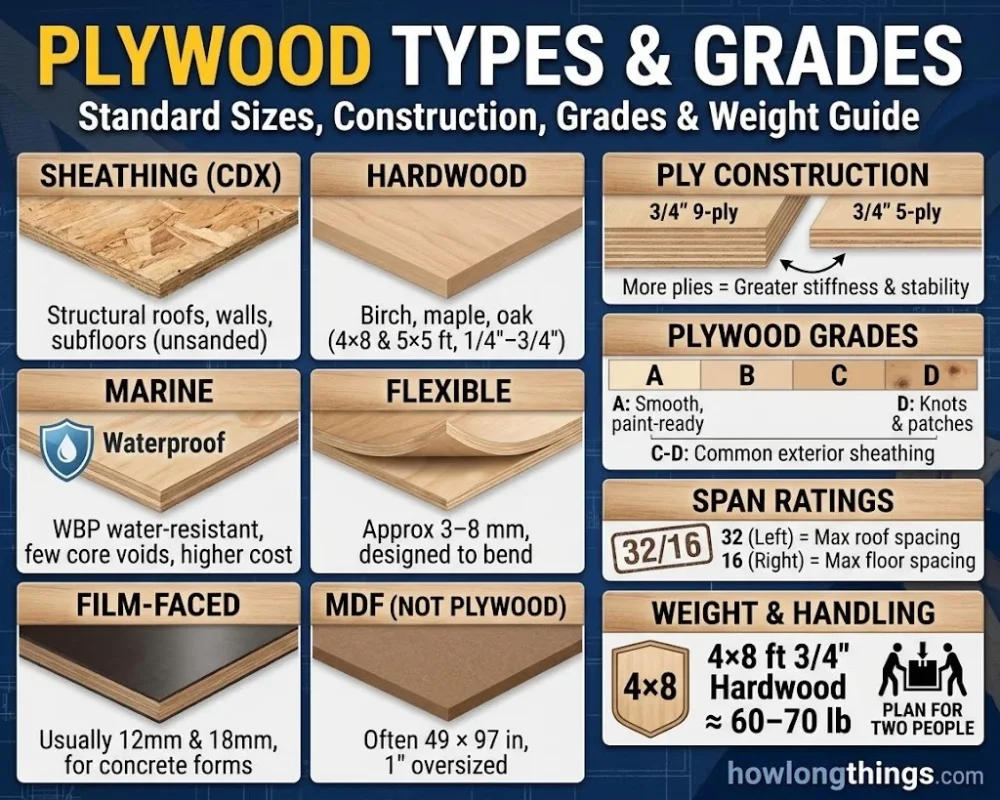
Sheathing (CDX): Structural panels for roofs, walls, and subfloors. Usually sold unsanded.
Hardwood plywood: Birch, maple, and oak. Sold in 4×8 and 5×5, mostly in 1/4 to 3/4 inch.
Marine plywood: Same footprint, but with a WBP water-resistant bond and fewer core voids. It costs more.
Flexible plywood: Thin sheets, about 3 to 8 mm, built to bend.
Film-faced (formwork) plywood: Usually 12 mm and 18 mm for concrete forms.
MDF (not plywood, but often shelved next to it): Often 49 × 97 inches. That is one inch oversized.
Plies and core: More plies means more stiffness at the same thickness. A 9-ply 3/4 inch sheet resists sag better than a 5-ply one. A veneer core is the common build, and a lumber core is stiffer.
Grades: Face grades run A, B, C, D. A is smooth and paint-ready. D has knots and patches. Exterior sheathing is often C-D.
Span ratings: US sheathing carries a rating from APA, such as 24/16 or 32/16. The left number is the max roof rafter spacing in inches. The right number is the max floor joist spacing. A higher pair means a stiffer panel.
Weight: A 4×8 sheet of 3/4 inch hardwood plywood weighs about 60 to 70 lb. Softwood runs lighter. Plan for two people.
How to Choose the Right Plywood Size and Thickness
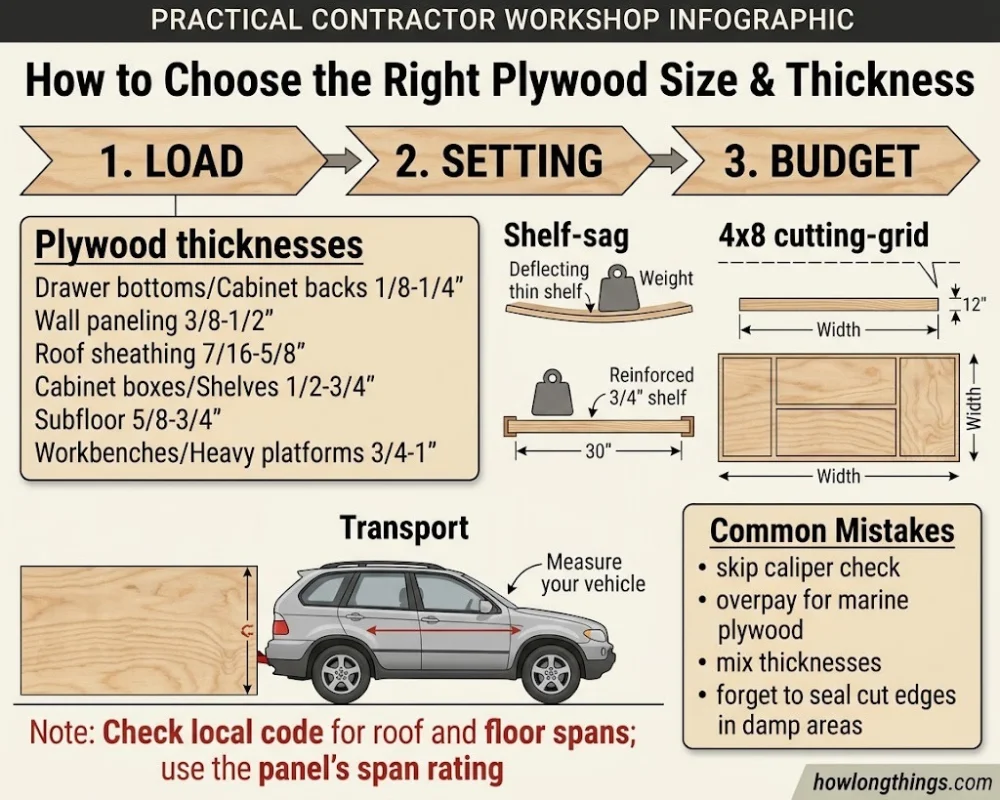
Start with the load, then the setting, then the budget.
Project
Typical thickness
Drawer bottoms, cabinet backs
1/8 to 1/4 in
Wall paneling
3/8 to 1/2 in
Roof sheathing
7/16 to 5/8 in
Cabinet boxes, shelves
1/2 to 3/4 in
Subfloor
5/8 to 3/4 in
Workbenches, heavy platforms
3/4 to 1 in
Check local code for roof and floor spans. The span rating on the stamp tells you what a panel can do.
Why shelves sag: Long spans with thin plywood deflect. Use 3/4 inch for shelves longer than about 30 inches, or add a front edge strip or a cleat to stiffen them.
Cut plan tip: Sketch your cuts on a 4×8 grid first. Group pieces by width to cut waste. Cut full sheets in the yard or on a table saw with a support, not on the grass.
Transport tip: A 4×8 sheet will not fit flat in most SUVs. A pickup bed is 48 inches wide between the wheel wells only on larger models, so measure yours. Many stores will cut a sheet into smaller panels for you.
Common mistakes:
Skipping the caliper check on the stack
Paying for marine plywood when exterior sheathing will do
Mixing thicknesses in one project
Forgetting to seal cut edges in damp spots
Plywood Dimensions FAQs
What are the standard dimensions of plywood?
The standard size is 4 ft × 8 ft (48 × 96 inches, or 1220 × 2440 mm). Common thicknesses run from 1/8 inch to 1-1/4 inch. Other sheets like 4×10, 4×4, and 5×5 ft also exist.
How big is a 4×8 sheet of plywood?
It measures 48 inches wide by 96 inches long. That equals 32 square feet, or about 2.97 square meters.
Is 3/4 inch plywood really 3/4 inch thick?
No. It is usually about 23/32 inch (roughly 18 mm). Some panels read closer to 21/32 inch. Always measure with a caliper before cutting joints.
What are the standard dimensions of a sheet of plywood?
The size is 4 × 8 ft for most US sheets. Metric versions are 1220 × 2440 mm or 1250 × 2500 mm. Hardwood plywood is also sold as 5 × 5 ft squares.
What is the size of plywood in inches?
The standard sheet is 48 × 96 inches. Other sizes include 48 × 120, 48 × 144, 48 × 48, 60 × 60, and 24 × 48 inches.
What is the price of 6×4 feet of 12mm plywood?
I could not find a verified price for this exact size, so treat this as an estimate. A 6×4 ft panel is 24 square feet, or 75% of a 4×8 sheet. Retail price guides often list 1/2 inch (about 12 mm) sheathing near $25 to $45 per 4×8 sheet. By area, that works out to roughly $19 to $34. Hardwood, birch, and marine grades cost more. A 6×4 ft panel is not a common US stock size, so you may pay for a full sheet and cut it. Check your local store for today’s price.
Conclusion
Know yourplywood dimensions before you buy. Check the sheet size, then measure the real thickness with a caliper. Match thickness to the load and span, and plan your cuts on a 4×8 grid.
Elizabeth Queen is a Owner and consumer research writer at HowLongThings.com, specializing in product lifespan, durability, and everyday household research. She’s passionate about helping readers make smarter, longer-lasting buying decisions.